Introduction
Copper fittings are essential in nearly every residential, commercial, or industrial water system in Australia. From connecting copper pipes to changing water direction, making branches, adapting pipe sizes, and installing connections for valves and fixtures, your choice of copper fittings will help you install a durable, user-friendly pipework system for your bathroom, kitchen hot water system, or even your commercial property.
Plumbers favour copper for its durability, thermal range, and the many approved ways it can be connected. It is also well understood, so it extends easily where existing copper pipework is in use. Yet fitting selection isn’t simply about choosing the right size to match a pipe; you must also consider the fitting’s application, pressure and temperature ratings, connection type, compatibility with other materials, and any relevant Australian standards.
In this guide, plumbing fitting types we discuss the most common types of fittings for copper plumbing fittings Australia range, the relationship between fitting sizes and copper pipe sizes, and where each type of fitting is commonly used. We also cover installation techniques, tools used, maintenance costs, plumbing careers, and the field service business in plumbing.
What Are Copper Plumbing Fittings?
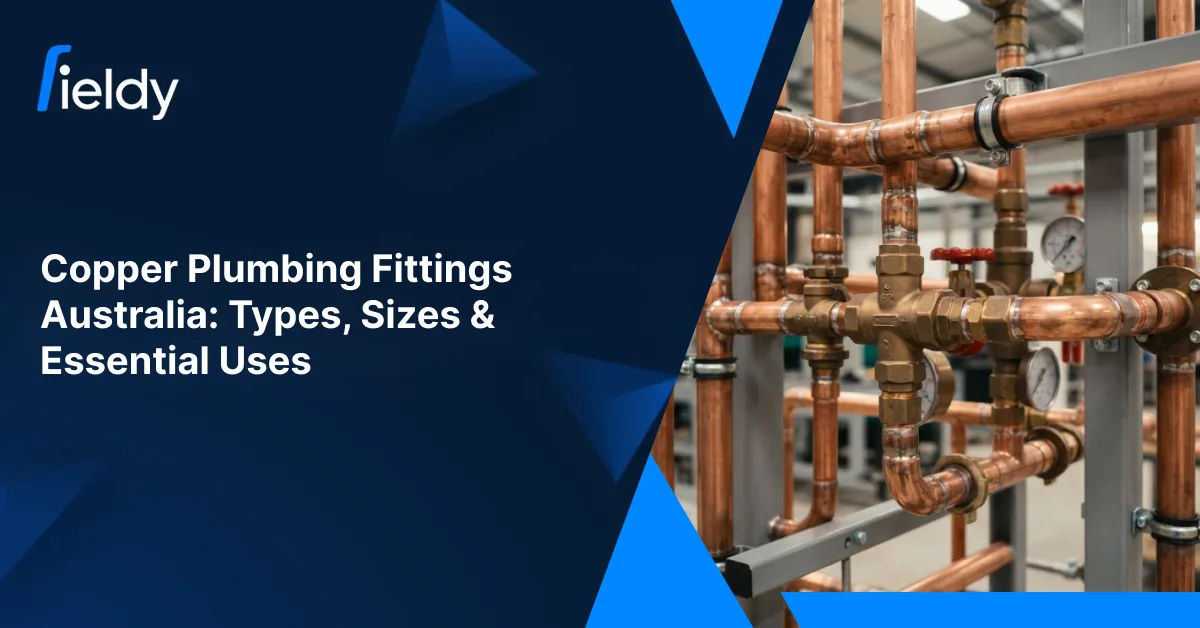
Copper fittings are connectors intended to join, divert, branch, reduce, or terminate the work of copper pipework. Copper fittings are used within systems of hot and cold water supplies, as well as in certain parts of the heating and cooling systems. A fitting provides a point of connection between pipe sections and, optionally, a pipe and another fitting, for example, a valve, tap, or other connection.
Fittings for copper piping come in different shapes and connection styles. Certain fittings are meant for soldered connections, and other types are press-fit or mechanically connected. The specific style you should use is determined by the pipe size and requirements, environment, and manufacturer directions.
Benefits of Copper Plumbing Fittings
Copper offers reliable performance, providing longevity and the capacity to carry hot water when pipework and fittings are specified and fitted correctly. Copper also resists most types of corrosion but, like any metal, corrosion can occur in all water conditions. The chemistry of the water, fitting methods, proximity to other metals, and exposure to the environment all have an impact.
Other benefits include:
- Durability: Copper pipework can provide a long service life when installed under suitable conditions.
- Temperature tolerance: Copper is commonly used in hot and cold water systems, subject to product specifications and system requirements.
- Established connection methods: Plumbers can use soldered, brazed, press-fit, or other approved connection systems where appropriate.
- Repair compatibility: Copper fittings can be useful when extending or repairing existing copper installations.
- Availability: A wide range of fitting types and sizes is available through plumbing suppliers.
Copper is not necessarily the best choice for every project. Material selection should consider installation cost, access, water quality, local requirements, and compatibility with the rest of the system.
Copper Pipes vs Copper Fittings
Copper pipes are the lengths of tubing that carry water through a plumbing system. Copper fittings are the components used to join those lengths or connect them to other parts of the installation.
Examples include a straight pipe made of copper, which runs through a wall or ceiling. An elbow will change the direction of the pipe run, while a tee could branch off to another fixture, and a coupling could be used to connect two pipe ends together. A reducer could also be used to connect two pipes of differing diameters, while a cap could be used to blank off a pipe end.
So yes, both pipe and fittings can be made from copper or other metal pipe material, but you cannot substitute a fitting for a pipe. They must be the correct size and able to join the type of pipe.
Australian Plumbing Requirements
Fittings for Australian plumbing must be approved for use in Australian plumbing systems; fittings must be fit for purpose and meet the appropriate standards. The Plumbing Code of Australia sets the national standards for plumbing and drainage systems. The applicable standards, state and territory standards, product certification requirements and manufacturer’s instructions also need to be taken into account.
A fitting that has a physical connection to a pipe is not necessarily acceptable for drinking water, hot water, or a given pressure application. Plumbers need to verify the acceptability and compliance of the product before installing.

Types of Copper Plumbing Fittings in Australia
Copper fittings are manufactured in many different configurations. It is important for plumbers to know the purpose of the fittings so they can select the fitting that best suits the route of the pipe and the operating conditions of the system.
Copper Elbows
Copper elbows are used to alter the direction of a pipe run. These are usually 45- and 90-degree elbows, but other angles are available, including special variations.
90-degree elbow is used to turn the pipe 90 degrees, such as when a pipe turns to go around a wall, connects to a fixture, or turns in a ceiling or service space. A 45-degree elbow is a less abrupt directional change than a 90-degree elbow.
Elbows are very useful in tight corners, but placement should be considered carefully. The fitting must be accessible where necessary, and the pipe route should steer clear of unnecessary bends that could make it difficult to install, examine, or maintain in the future.
Copper Tees
A copper tee is a type of fitting that makes a branch connection from the main pipe. Tee fittings are usually three-port fittings where 2 ports are in parallel with the main pipe and 1 port is perpendicular to the parallel ports.
An equal tee has both openings at the same nominal size. It might be appropriate to use where the main pipe and branch are the same size. A reducing tee will have a smaller branch opening to connect to a different size pipe.
Tees are used to share water between fixtures. A main supply line may route a tee to a basin or kitchen tap. The size and orientation of the fitting should be selected based on the required flow, overall system design, and installation requirements.
Copper Couplings and Unions
Copper couplings connect two sections of pipe together in a straight line. They are ideal if you’re extending existing pipework, repairing a section of broken pipe, or joining two pipes together during installation.
A coupling is normally designed to provide a permanent or semi-permanent connection, given the construction and method of joining. However, a union is designed to provide a detachable connection. Unions may be handy to use in proximity to equipment or components that might need to be serviced or replaced.
This can be important for planning. A connection that may be wanted for future access must be designed with appropriate isolation and disconnection facilities instead of requiring pipe cutting during servicing.
Copper Reducers and Adaptors
Reducers connect pipes or fittings of different diameters. They may be used when a larger supply line branches into a smaller line or when an installation transitions between different pipe sizes.
An adaptor is used to link copper pipework to a different component or material. An adaptor may connect copper to a threaded valve, to a plumbing fixture, or to a different pipe system.
The connection should be compatible with the materials and conditions of operation. Compatibility should be checked when switching pipe or metals, as well as pipe material, and take note of the manufacturer’s installation requirements to prevent corrosion, leakage, or mechanical failure.
Copper Caps and Plugs
Some form of cap or plug is used to shut ends of pipes or unused couplings. The size of the cap usually covers or surrounds the end of the pipe; the plug is designed for a matching opening.
May be employed during installation, renovation, testing, or repair. Temporary closures might assist in safeguarding pipework through the process of work. However, temporary fittings should not be confused with the permanent, regulatory fitting.
The cap or plug chosen must be compatible with the size of pipe or fitting and capable of withstanding the pressure and use. Any temporary arrangement must be made safely and dealt with or replaced in good time before commissioning.
Copper Plumbing Fitting Sizes and Dimensions in Australia
Copper fitting sizes will be based on the pipe to be attached to the fitting. There is not always a size label that accurately describes the outside diameter, the inside diameter, or the wall thickness of the pipe. What the manufacturer or supplier may use is different.
Nominal pipe size may refer to a nominal dimension, with actual outside diameter and wall thickness specified by the product specification. The internal diameter may also depend on the wall thickness of the pipe. This is important since the internal diameter affects flow capacity and pressure loss.
Choose a fitting per the type of pipe system used and manufacturer compatibility information. Always ask the plumber not to assume two products with similar labels will really join together as a compatible connection.
Common Copper Fitting Size Reference
The table below offers a general reference for common nominal size categories and their typical applications. It is not intended as a design schedule or a universal specification. Availability and suitability depend on the product, pipe standard, connection system, and installation requirements.
| 🔧 Fitting Type | 📏 Common Size Range | 🏗️ Typical Application | 📌 Compatibility Notes |
|---|---|---|---|
| Elbows | Small to large domestic and commercial pipe sizes | Changing pipe direction | Match the elbow to the pipe’s specified dimensions and joining method |
| Tees | Common domestic sizes through larger distribution sizes | Creating branch connections | Equal and reducing configurations serve different layouts |
| Couplings | Sizes matching the pipe system | Joining straight pipe sections | Confirm whether the coupling is intended for the selected connection method |
| Unions | Common fixture and equipment connection sizes | Removable connections | Check thread type, sealing arrangement, and application |
| Reducers | Combinations of larger and smaller sizes | Connecting different pipe diameters | Confirm flow requirements and approved configuration |
| Adaptors | Sizes and connection types vary | Connecting copper to valves or other components | Check material compatibility and thread or connection specifications |
| Caps and plugs | Sizes matching the relevant pipe or fitting | Closing pipe ends or unused outlets | Confirm pressure suitability and whether the closure is temporary or permanent |
Nominal Size, Outside Diameter, and Wall Thickness
Nominal size is the term used to group together a pipe or fitting into a category. It is not the same as the internal size or diameter of the pipe. Nominal outside diameter is the size across the outer face of the pipe. Wall thickness is the distance between the outside diameter and the inside diameter.
The thickness of the wall can change the inside diameter of the pipe and the correct application for the pipe. It also determines the size of fittings that can be used with the pipe and the method of joining that can be used.
Before purchasing or installing copper fittings, verify:
- The standard and size of the pipe.
- The true outside diameter for the applicable areas.
- What it is designed for.
- The pressure and temperature rating you need.
- How the connection will be made and the equipment needed.
- Product certification or installation requirements, if applicable.
A product selection for copper plumbing fittings in Australia is based on the documentation of the products and the requirements with which the product has to comply rather than the size label.
Common Uses of Copper Plumbing Fittings
Copper fittings are used in many parts of a plumbing system. Their role depends on the layout, the type of fixture, and whether the pipework carries hot or cold water.
Hot and Cold Water Supply Systems
Copper fittings allow you to join and transfer your hot and cold supply lines across the building. Elbows, tees, couplers and adaptors are used to direct pipework to fixtures and appliances.
Hot water system fittings should be rated for the pressure and temperature under which the system will operate. The system installation should consider expansion support, isolation and maintenance access. The cold water lines should be fitted with appropriately pressure-rated components and be protected from environmental conditions.
Bathroom Plumbing
In a bathroom, you’ve got various fixtures that need their own supply and drainage system. Copper fittings could be used to join cold and hot water supplies with sinks, baths, showers, and other fixtures. The arrangement of these fittings will be specific to the bathroom’s setup and the type of fittings being used.
A bathroom plumbing diagram in Australia is used to communicate fixture location, supply arrangement, and the position of the bathroom within the overall plumbing system. A diagram on its own does not ensure compliance; there are other on-site requirements to check.
Kitchen and Laundry Installations
Copper fittings could be used to supply sinks, taps, and appliances that are compatible. Tees and adaptors could be used to connect individual outlets, while isolation valves could be used to make maintenance more straightforward.
Laundry areas could involve taps, tubs, washers and appliances, or hot water services. All connections should be installed to provide access to the valves, and also to ensure that they are protected from being knocked, vibrated, or jarred.
Commercial Plumbing and HVAC Applications
Specialist copper pipework is also installed in some commercial buildings. Such as heating, air conditioning, and ventilation (HVAC) systems, where copper pipework may contain refrigerant or water, according to the particular installation. These need to be fitted with the appropriate fittings for the operating conditions and the equipment.
Commercial HVAC equipment in Australia refers to an area of building services that, in some circumstances, applies equally to the characteristics of the equipment fitted. Copper fittings for HVAC should be selected per manufacturer’s specifications, pressures, refrigerants, and standards. Plumbers’ fittings for domestic water supplies should not necessarily be used for refrigerant pipework.
Repairs and Extensions
Copper fittings are used when repairing an existing copper pipework or increasing the size of a system during renovations. A coupling is used to connect an additional section of pipe or an adaptor to connect new pipework to an existing valve or part.
The plumber should ascertain the pipe material, the condition, size, and system requirements before repairing. The component may look badly damaged, but this may not be the case if the rest of the pipework is corroded, unsupported, or otherwise inappropriate.

How to Choose the Right Copper Plumbing Fittings
Choosing a fitting requires more than selecting a shape. The fitting must suit the pipe, the application, and the operating conditions.
Match the Pipe Diameter
Verify the pipe size and specification; the fitting should be relevant to the pipe size and connection style. In the case that the pipe is already old or the specifications are unknown, measurement and product identification may be required.
Never depend solely on a visual comparison or a generic size indication. An incorrect size indication could result in inadequate joint formation, leakage, or a joint that cannot be installed properly.
Consider Pressure and Temperature
Ensure that the fitting is rated for the pressure and temperature of the system. For example, hot water systems can operate under very different conditions than cold water supplies, and commercial fit-outs may have additional specifications.
Ensure the fitting’s rating is appropriate for the system design and check manufacturer specifications. Contact a professional plumber if pressure or temperature will be unknown or variable.
Check Connection Method
Copper fittings are designed for soldering, brazing, press fit, and mechanical fittings. Each of those methods will use different fitting styles and preparation methods.
Solder fittings are not consistent with press-fit fittings. Also, press-fit connections will require the right fittings, the right jaws or tools, and the installation procedure from the manufacturer.
Confirm Material Compatibility and Product Suitability
Copper can be joined to valves, fixtures, or other pipe materials. These transitions should be engineered with material compatibility in mind. The junction of different metals can cause corrosion in some cases, while incorrect fittings or sealing materials can allow leaks to form.
Products used for potable water should comply with the requirements of potable water where appropriate. Ensure that the product is certified, and that the manufacturer’s instructions and intended use have been considered.
Copper vs PEX Plumbing
A typical question when comparing plumbing materials is what is PEX plumbing. PEX is cross-linked polyethylene tubing made for use with some hot and cold water plumbing systems. PEX tubing can be bent to fit around certain barriers, eliminating some fittings, which are rigid and made of copper. PEX is joined with a fitting system approved for PEX, such as crimp, clamp, or expansion fittings.
Material Choices: PEX and copper are both rigid and connected by soldered, press-fit, or other approved means. PEX and copper require different installation procedures and have different temperature and pressure ratings and restrictions, and each has their own compatibility requirements. Neither PEX nor copper is suitable for every project without further considerations in system design, end use, approvals, and cost.
Copper Plumbing Connection Methods and Installation
Copper pipework can be joined using several methods. The selected method must be suitable for the pipe and fitting, the operating conditions, and the installation environment.
Soldered Connections
Soldered joints are made by heating compatible copper fittings and pipe with the correct soldering material. The joint is formed by clean, properly prepared pipe and fittings and, where recommended, flux applied with the correct heat.
Soldering is not a new technology for copper water pipework, but it does require a bit of care. Poor preparation, overheating, not heating enough, or moving the joint before the solder has cooled can cause the joint to be weak or leak.
Brazed Connections
Joining temperature is higher than in soldering, and it should only be used where the system and materials necessitate it. It is often used in certain specialised pipework and HVAC applications.
Brazing is not just going to be soldering on steroids for the entire plumbing process. The process may be more applicable to the product specification as well as the requirements. The temperature is high, which leads to some other fire safety concerns.
Press-Fit Connections
These fittings and tools have been designed to form a mechanical connection. Insert the fitting over a prepared pipe end and press with an approved pressing tool and matching jaw or ring.
An advantage of press-fit installation is the extent to which open flames may be eliminated overall; this can be an advantage in certain renovation situations. It’s essential to follow the system installation instructions precisely. Pipe preparation, penetration tools, and inspection are factors to consider.
Preparation and Leak Testing
Regardless of how the fittings are joined, they need to be prepared properly with properly measured cuts, deburred, cleaned, checked for alignment, etc. Do not force the joint into place if the pipe is bent or malformed.
Once installed, the system shall be tested and commissioned as per the requirements and manufacturer instructions. Testing can reveal leaks or installation issues before the pipework is hidden or re-commissioned.
How to Solder Copper Plumbing
By prepping and joining, there’s a process on how to solder copper plumbing, but this job should be performed by people who have the proper training and are following safety guidelines.
The general process includes:
- Identify the correct water supply and check that you can access the pipe.
- Use a pipe cutter to measure and cut the pipe, ensuring you cut square.
- Clean burrs and prepare pipe end and fitting surfaces as indicated.
- Clean mating surfaces with appropriate hand and power tools.
- Use the indicated flux, if necessary, in the required quantity.
- Put the whole joint together and make the pipe tight.
- Follow the instructions for the solder manufacturer and apply controlled heat from appropriate equipment.
- Allow the joint to cool without moving it.
- Check the joint and perform the tests indicated before the system goes back into service.
Typical reasons for poor joints are dirty surfaces, too much or insufficient heating, inadequate flux applied, incomplete insertion, and movement while cooling. Fire hazards are caused by open flames, hot surfaces, and sparks. The heat produced may set fire to adjacent materials, scorch finishes, and burn exposed skin. Use proper fire precautions, PPE, and venting.
Copper Press-Fit and Mechanical Connections
In the press-fit system, a suitable fitting series and suitable press-fitting tool are necessary. The tool series and possible jaw pieces, insertion depths, and inspection procedures differ based on the manufacturer. A tool that physically fits does not necessarily have to be approved for the fitting.
Mechanical joints may be threaded, compression, or assembled in some other way. The installation procedure differs. Compression and threaded joints should be installed per the manufacturer’s instructions and should be located so that they can be accessed when the system is inspected or serviced.
Copper Plumbing Tools and Supplies Needed for Installation
The right equipment is essential for ensuring correct fitting and secure joints. The equipment you need will vary based on the type of connection and the job complexity.
Typical supplies, accessories, and items may include:
- The length and diameter of pipe cutters.
- Measuring tape and marking device.
- Deburring or reaming tools.
- Brush cleaning and approved preparation material.
- Recommended connection parts for soldered, brazed, and press-fit systems.
- Matching fittings, valves, and adaptors.
- Testing system suitable for the system.
- PPE and fire-safety equipment as applicable.
Plumber tools refer to the tools of the trade that are needed to measure, cut, assemble, join, and test plumbing systems. Correct use of the right tools can minimize installation errors and maximize quality of work.
Some HVAC tools in Australia used by technicians when working on an HVAC system may be dedicated appliances for refrigerant piping, pressure testing, evacuation, and commissioning. Some HVAC tools are specific to an application and should not be used as plumbing tools or requirements, unless known to be appropriate.
The needs in sourcing plumbing supplies in Australia would be met when customers verify the product’s specifications, size compatibility, and certification, if any, for the function it is intended to perform. The availability of suppliers does not prove the suitability of a product for a specific installation.
Other replacement and repair items for use with plumbing parts in Australia could include couplings, adaptors, valves, caps, and fitting ends that are suitable. It helps to determine the pipe system and component correctly to avoid getting an incorrect part.
Copper Plumbing vs Other Pipe Materials
Copper is just one of many products used in a plumbing system. PEX and PVC are other popular plumbing supplies, but they all serve different purposes within a plumbing network. Don’t choose a plumbing pipe product just because a plumber seems to prefer it.
Copper vs PVC
A lot of drainage and other plumbing fittings can be made of PVC, to suit the product specification. It will normally be connected using techniques suitable to the PVC system. Copper fittings, which are more generally employed in water supply installations, are usually connected either with soldered, press-fit, or mechanical connections.
The materials have varying temperature constraints, mechanical properties, and application needs. PVC products designed for drainage should not be used in pressurised water supply pipework unless explicitly approved and designed for this use.
Copper vs PEX
PEX is pliable and can be advantageous for curved pipe routes or quick installations; copper is inflexible and is a good option for exposed installations, repairs, and situations where existing pipework is copper.
Material and labour prices may change from project to project. For some designs, the overall number of fittings needed may be lower with PEX; whereas for other designs, PEX fittings may be easier to include into an existing copper system. Consider product specifications, access at the site, installer skills, and ease of long-term maintenance.
Copper in Automotive HVAC Systems
Body Kit Glossies by type vehicle Climate-Control products could be found in automobile climate-control, though vehicle climates are different from building plumbing. The Australian automotive HVAC market is the market of equipment for vehicle heating and cooling, where tubing, fittings, refrigerants, pressures, and service procedures are meant for vehicle systems.
Automotive HVAC parts should never be swapped for fittings designed for normal water supply and drainage in the home or office. These tests are useful only as examples of the installation and system conditions.
Copper Plumbing Repair and Maintenance
Copper pipework can develop leaks, corrosion, or damaged connections over time. Regular inspection and appropriate maintenance can help identify problems before they cause significant disruption.
Common Copper Plumbing Problems
Potential issues include:
- Joint leakage due to poor installation, movement, or deterioration.
- Due to water chemistry or environment.
- Broken fittings due to impact or improper handling.
- Piping moving because of lack of support.
- Split-rail connections on the end of a row.
- Clogs or slow flow somewhere in the plumbing system.
A leak you can see does not always mean the issue is obvious. A leak near a fitting can be caused by the water itself, installation of the fitting, or because the fitting is touching another material. A plumber will need to review the system to determine if they should change the fitting, a length of pipe, or more.
Inspection and Preventative Maintenance
This process may involve inspecting available joints for potential leakage, inspecting for corrosion/staining, ensuring pipe supports are stable, and inspecting valves and fittings for deterioration.
You won’t see pipework hidden within walls or floors. Consider keeping a record of where pipes run and their connection points when it is being renovated, so it can be maintained if necessary. Stop the water supply if you notice a leak (as long as it is safe to do so) and call the plumber.
How to Use a Plumbing Snake
How to use a plumbing snake depends on the drain and the type of blockage, like a clog in a waste pipe. This is a device used for the drain snake to help get rid of specific blockages.
But it’s not for fixing pressurised copper water pipes. A snake will only be used where suitable for the drain type and the type of blockage. Using it incorrectly can cause damage to the pipework, traps, or fittings. Consider consulting with a qualified plumber for continued blockages, drainage issues, or any damaged pipes.
Supporting Vertical Pipework
Our guide on “How to use riser clamps plumbing” details about supporting other vertical pipework, including riser clamps and other pipe supports to secure a pipe and control its weight, movement, and location. The type and spacing of the support will depend on pipe material, size, and installation arrangement.
Supports must be installed as per the system design and instructions supplied with it. The supports must not damage the pipe or restrain required movement. Proper supports can also minimise stresses on fittings and connections.
Does Homeowners Insurance Cover Plumbing?
Coverage for plumbing-related damage depends on several factors, including your policy and the cause of the issue, which is why understanding whether homeowners insurance covers plumbing can help you know what to expect. Some policies may cover damage to floors, walls, or other property caused by a broken pipe, while the cost of repairing the pipe itself may be excluded. Coverage also varies depending on policy exclusions, maintenance requirements, and how quickly the damage is reported.
If and when a home plumbing incident occurs, homeowners should examine their policy wording and consult with the insurer. They shouldn’t assume that every plumbing leak or repair is a covered event.
Copper Plumbing Costs in Australia
Copper fitting costs depend on the type, size, connection, material type, quantity, and the seller. For instance, a small coupling and a big reducing tee may not be as cheap as the other. There could be cases where special fittings and fittings that are for specific jobs could be costlier than the other.
More than fittings make up the value of your plumbing project. Labour, access prep, testing, isolation, and the route of the pipe are factors that influence the final estimate. Working in tight spaces like a sealed ceiling, wall cavity, or business can also impact time and planning.
Factors That Influence Fitting Costs
Common cost factors include:
- Fitting type: Elbows, tees, adaptors, unions, and reducers have different designs and manufacturing requirements.
- Size: Larger or less common sizes may have different supply costs.
- Connection method: Press-fit, soldered, and specialist connection systems may have different material and tool requirements.
- Quantity: Larger projects may require a broader range of components and more material.
- Supplier and availability: Product availability and supplier pricing can vary.
- Installation access: Difficult access may increase labour time.
- Testing and compliance: Required inspection, testing, or documentation can affect the scope of work.
Estimating Plumbing Work
How much does plumbing cost is most easily answered by considering what work is necessary. If you simply need a fitting replaced, it may be quite different from replacing a whole bathroom, installing a new water supply line, or commercial installation.
A good estimate should also list the work covered by the quote; include materials and fittings to be installed and access considerations; describe any anticipated testing; and note if further repairs might be necessary. If the condition of existing pipework is unknown, it should address the likelihood of additional work, not attach a fixed price to it.

Plumbing Careers, Training, and Business Management
Trade plumbers qualify in work involving the installation, testing, commissioning, and maintenance of copper piping systems. The employment of a trade plumber involves practical skills, technical knowledge, and may include some licensing or compliance elements.
Each State and territory has different training pathways, licensing requirements, and authorisation criteria. If you are new to the trade, research the licensing requirements in your State or territory and undertake the required training and supervised practical experience.
Related HVAC Training
HVAC courses in Australia might include training on heating, ventilation, air conditioning, refrigeration, and other building services. HVAC and plumbing share some building system work, but they are separate careers.
Having an HVAC qualification does not mean you have a plumbing qualification or that you can perform licensed plumbing work. People considering either trade should always check with their relevant state or territory authority on training, licensing, and work obligations.
Types of Plumbers
What are the types of plumbers? Residential plumbing focuses on areas like bathrooms, kitchens, hot water systems, and residential repairs. Commercial plumbing includes such things as office buildings, retail centres, industrial sites, or large residential developments. Maintenance plumbing may refer to a range of tasks such as fitting new fixtures, repairing leaking sinks and blocked toilets.
There are those who specialise in fault-finding and maintenance, and others who fit new or renovated buildings. Their work can involve a very different set of working conditions and technical skills.
Plumbing Career Earnings
Australia plumbing salary is all about what you will be earning within the Australian plumbing industry. Salary and wages may be different according to a number of factors like qualifications, licensing region, years of experience, type of employment, specialisation, and even being an employee or the business owner.
A valid salary comparison would be based on up-to-date Australian labour-market or job-market data and disclose the name of the occupation category used, and the reporting period for the data. A single salary range may not reflect all plumbing jobs.
International Salary Comparisons
Plumbing salary in the UK is of interest only when comparing a career in Australian plumbing with the job prospects in the United Kingdom. An appropriate comparison would take into account exchange rates, taxation, cost of living, licensed employee earnings versus contractors’ income, etc.
An international salary figure can be misleading without a clear comparison and current data. For this article, focused on Australian news rather than providing a large discussion, this is a topic best touched on as a brief comparison.
Certifying Plumbers and Compliance
A certifying plumber is a licensed practitioner who may have certification or compliance work under the jurisdiction’s relevant legislation. The exact job title and powers will vary in different states and territories.
Plumbing businesses should be aware of the types of work that require certification, inspection notification, or some other form of paperwork. These should be checked with the relevant regulator rather than assumed to be the same across Australia.
Customer Demand and Business Planning
There is no one-size-fits-all answer to the question of how many customers the average plumbing business have. The number of customers can also vary based on the type of business model, region, team size, work category, ongoing maintenance arrangements, and marketing levels.
A plumbing company specializing in emergency repairs might have many one-time customers, but a commercial contractor might work with just a handful of customers with long-term contracts. When planning the business, don’t just look at the number of customers. Think about volume, repeat work, technician capacity, travel time, and profit.
Managing Copper Plumbing Jobs and Field Service Operations
Installation and repair, communication with customers, visibility of technician schedules, work materials, and jobs plumbing businesses have a lot to manage. An effective operation can help cut down on missed appointments and give your team clear schedules to stay consistent.
Apps are useful for scheduling, dispatching, quoting, invoicing, customer records, and work planning. The usefulness of an app depends on how well it integrates with the business’s workflows and technician needs.
Field Service Software for Plumbing Businesses
A field service software solution can allow a plumbing business to take control of service work, from scheduling the work to concluding the job. It may have: customer records, job info, scheduling, quotes, and invoicing reporting.
One spot for job information for a plumbing contractor can eliminate duplication of administrative work and assist office personnel in coordinating job execution with technicians working in the field.
Plumbing Field Service Software
Plumbing field service software is intended to assist the workflows of plumbing contractors and plumbing field technicians. It can assist in the tracking of customer jobs and requests, job sites, work notes, parts, and service history.
Does the software support your standard operating procedures as a business, such as emergency work, planned maintenance, repeated visits, and documentation?
Field Service Scheduling Software
Field service scheduling software may enable you to assign appointments to a technician by his or her skills, location, or availability. This might be helpful when a company needs to schedule repairs or installations in multiple suburbs or service areas.
It can highlight conflicts, plan regular recurring maintenance, and adjust for new work when necessary. The schedule, in the end, should consider the actual travel times and job time frames.
Field Service Dispatch Software
Field service dispatch software helps businesses assign jobs to technicians and communicate relevant information. For urgent plumbing repairs, dispatchers may need to consider the technician’s location, current workload, required skills, and access to the right equipment or materials.
Accurate dispatch information can prevent needless travel and equip technicians to get the job done.
Field Service Quoting Software
Field service quoting software can help generate quotes for copper pipe repairs, fitting replacement, and plumbing installations. Quotes could include: labour, materials, access, scope of work, etc.
Templates and standard pricing can promote consistency, but your estimates should be representative of the actual conditions at the site and the specifics of the job.
Field Service Invoicing Software
Invoicing field service software allows a plumbing business to generate invoices to bill for completed work, bill for charges made, and monitor which invoices have been paid. Attaching invoices to the job record can enable a review of what was accomplished and what was billed.
These are particularly helpful if you are asked by a customer for any follow-up work, or if you want to look at your costs and margins.
Field Service CRM Software
If you have field service CRM software, it can help you keep customer information, history of communication, properties, and plumbing service records. This will be very helpful for companies that have to service several sites for the same customer.
A fully maintained customer file brings technicians with information as to what work has been carried out previously and, where relevant, information for their job.
Managing Plumbing and HVAC Teams
HVAC field service management software could be worth exploring for companies with both HVAC and plumbing service teams. Some may need to support different sets of skill sets tools job types, and service requirements.
The software would need to account for the operational differences between the trades and not just treat every service call the same.
Annual Maintenance Contracts
An AMC scheduling software can assist businesses with monitoring amounts, renewal dates, and various other recurring needs for annual upkeep contracts, as well as any kind of customer obligation. This can help with preparation and reduce missing out on scheduled jobs.
Commercial plumbing clients may have maintenance agreements like periodic inspections or established service cycles. Consider whether the scope of the contract and history of the service can be easily monitored.
Technician Location and Job Progress
Location information can inform a business about technician travel and help with job allocation with an employee GPS tracking app. Location data must be provided to the employee to clearly explain why it is being provided and used.
A field staff tracking app can further help with employee communication by helping mobile teams report job status and progress. Tracking solutions are no substitute for clear job orders, effective scheduling, and managing technician workload.
Copper Plumbing Layouts and Planning for New Installations
Copper plumbing installation is about understanding the building, fittings, and services. It is about measuring and planning. With this in mind, clear and precise measurements and co-ordination are most likely to mean fewer changes during installation.
The route should take into account the lengths of the pipe, the position of fittings, access support, points of isolation, and the position of other services. A line that looks obvious on a drawing may be restricted by structural elements, existing pipework or electrical services, or site conditions.
Planning Pipe Routes and Fitting Positions
The plumber will determine the position of each fixture and connection before installation. The pipe route should allow for ease of access during installation and at a later time and should not have any unnecessary bends and joints.
Position fittings so they can be assembled correctly and made accessible where needed. Support should be provided to the pipework and the arrangement should take into account any movement or expansion that may be necessary.
Consider the existing pipework for renovations. Sometimes you will have to connect new fittings to older pipework, and such connections should be carefully planned and not made on the fly.
Preparing a House Plumbing Layout
The term how to draw a house plumbing diagram is a bit of a misnomer: a plan that shows the position of plumbing fixtures, water supply lines, wastewater drainage, and associated plumbing fixtures. A drawing like this can help the homeowner, plumber, builder, and other trades work together.
Check the layout against actual site conditions and the current Australian standards. A conceptual drawing is not a replacement for a compliant plumbing design, specialist advice, or any necessary approval.
Confirming the Installation Before Work Begins
Before starting the work, verify pipe and fitting specifications, type of connection to be made, tools required, testing, and documentation requirements. Make sure that the products are appropriate for the application and that the installation will be safe.
With bigger builds, you can benefit from recording the position of installed pipe runs and fitting locations before any ceilings, walls, or floors are completed. This gives information for later servicing and repair jobs.
Conclusion
Copper plumbing fittings offer various options to support various needs and applications when designing or servicing a water distribution system. Elbows, tees, couplings, unions, reducers, adaptors, caps, and plugs all perform unique functions to connect the pipe and direct the flow. Selecting fittings is done by selecting the pipe sizes, connection pressure and temperature specifications, and use.
Copper continues to be an attractive option for residential, commercial, and some building-services applications, but it doesn’t automatically mean it is the best solution for your project. PEX, PVC, and other products also have benefits and limitations that will need to be considered for your particular system and its requirements.
Reliable copper plumbing installations rely on precise measurements, compatible products, proper tools, correct preparation, and suitable testing. Before installation, plumbers should review manufacturer documentation, applicable Australian standards, product appropriateness, and local licensing or compliance requirements.
The same is true in the plumbing industry. With proper planning, putting together a schedule for your technicians, communicating with clients, planning out your jobs, keeping up with records, and adhering to maintenance schedules will produce more consistent results. This can be a small repair or a big install; the key is quality materials and professional craftsmanship.