What Is Customer Service Experience in Field Service Management? A 2026 Guide

🏁 Introduction

💬 Why Customer Service Experience Matters in Field Service

The essence of customer service experience (CSX) has become the root of the long-term success for different industries like HVAC, elevator maintenance, pest control, or building security. It is the interaction with a client that leads to keeping a customer or losing him to a competitor. Chances are that in 2026, the service landscape as we know it, based on the factors of price or product differentiation, will be a thing of the past; rather, it will be all about customer satisfaction and the level of their engagement with the company.

📊 Research Insights: Consumer research indicates that the dominant view of customer service or customer experience, regarding the value a brand gives its consumers, is one of the most critical factors in deciding whether to switch or keep the brand. Just one bad service or a late message can be the reason for customers losing faith in the brand after years.

It is easy today to identify platforms like Fieldy, which have played the role of catalysts for the change. They do so by bringing together all the administrative, communication, and planning activities that are related to field service, thus enabling businesses to offer a very user-friendly and open service, starting from customer booking and ending with the customer experience at the site. There is a complete shift of the business’s focus from task completion as soon as possible to creating an emotional bond through predictability and responsiveness.

🤔 What Is Customer Service Experience in Field Service Management (FSM)?

Differentiation in Field Service Management (FSM) lies in understanding the customer experience journey, covering every touchpoint from digital engagement to on-site service and after-service communication. It defines how customers feel throughout their interaction with a service provider.

🔹Key aspects of customer experience in FSM include:

  • 🌐 Digital Engagement: Seamless booking, instant updates, and mobile accessibility.
  • 🧰 On-Site Performance: Technician punctuality, professionalism, and communication quality.
  • 💌 Post-Service Interaction: Feedback collection, service follow-ups, and personalized reminders.

🔸A clear distinction exists between customer service and customer experience:

  • Customer Service focuses on resolving specific issues or answering queries.
  • Customer Experience encompasses the entire relationship, from the first touchpoint to long-term trust.

🌟 Example:
If a technician simply repairs a faulty unit, that’s service. But if the technician arrives on time, greets the customer by name, and offers preventive maintenance tips, that’s a customer experience that builds loyalty.

Why it matters for field service companies:

  • Customers today expect more than problem-solving; they want empathy, personalization, and efficiency.
  • Companies that merge technology with human touch consistently outperform those that don’t.

Here’s where Fieldy’s Customer Experience Management Software stands out:

  • Integrates CRM data, real-time tracking, and feedback systems into a single, easy-to-manage platform.
  • Enables teams to understand customer behavior, improve communication, and deliver consistent service excellence.

This aligns perfectly with how modern field professionals operate, combining tech-driven efficiency with human empathy to ensure customers feel valued at every stage.

Moreover, these strategies connect directly with how to measure customer experience in FSM software, using metrics and feedback to continually evaluate and enhance service quality. 🔽🔽🔽
CTA Banner 1

🧱 Key Elements That Define a Great Customer Service Experience in FSM

Delivering an exceptional customer experience requires alignment across several core pillars: transparency, speed, convenience, consistency, and feedback.

🔍 Transparency

Customers today value visibility above all. Providing real-time technician tracking, live job status, and proactive communication establishes confidence.

📈 Insight: For instance, when a pest control company offers live updates, customers are 40% less likely to cancel appointments or request rescheduling.

Speed

Service timeliness remains a crucial differentiator. Automated dispatching and route optimization ensure technicians arrive on schedule, reducing delays. Leveraging Fieldy’s field service scheduling software, companies can allocate the nearest available technician, boosting on-time arrivals and first-time fix rates.

🪄 Convenience

The modern customer expects frictionless access to services, whether booking an appointment, making a payment, or rescheduling a visit. FSM-integrated booking tools simplify this process, allowing 24/7 access and self-service convenience.

🔁 Consistency

Uniform service delivery builds credibility. Through standardized workflows and digital service records, businesses can guarantee the same quality experience, regardless of who performs the job.

💬 Feedback Loop

Post-service surveys and rating systems allow for constant improvement. By collecting structured feedback, FSM providers can detect weak areas and turn every service into a learning opportunity.

When integrated effectively, these five components illustrate what makes a great customer experience: a seamless, reliable, and personalized interaction that turns one-time customers into long-term advocates.

📅 How Field Service Online Booking Software Improves Customer Experience

The booking process often defines the customer’s first impression of your brand. Long waiting times or complex scheduling steps can cause frustration even before service begins.

Fieldy’s online booking software, part of its FSM ecosystem, eliminates this friction by enabling 24/7 appointment scheduling, instant confirmations, and automated reminders. Customers also benefit from reduced wait times, as bookings sync directly with technician calendars.

🧾 Case Study:

A practical example comes from an HVAC firm that integrated Fieldy’s booking module. Within six months, it saw a 30% increase in repeat appointments and a noticeable drop in cancellations. The convenience of instant booking and consistent reminders made a lasting impression on their customers.

Beyond convenience, online booking delivers valuable insights, like peak demand trends, booking-to-service ratios, and effort scores, helping optimize technician schedules. FSM companies using the best booking software can anticipate customer needs, balance workloads, and streamline operations for higher satisfaction and efficiency.

💡 Using Customer Experience Management Software to Build Loyalty

Building loyalty in field service depends on how well a company anticipates needs rather than reacts to issues. That’s where customer experience management (CXM) software reshapes engagement.

With centralized data and automation, FSM businesses can deliver proactive and personalized service. Fieldy’s CX tools, for example, help companies:

  • Maintain a unified customer database containing preferences, service history, and prior feedback.
  • Send automated AMC or maintenance reminders to ensure ongoing touchpoints.
  • Provide live technician tracking for transparency and reduced wait anxiety.
  • Track team performance to ensure consistent service standards.

🧾 Case Study:

An elevator maintenance provider using Fieldy’s CX suite saw customer renewals increase by 27% and recurring complaints drop 40% within eight months, thanks to improved transparency and timely service. 🔽🔽🔽
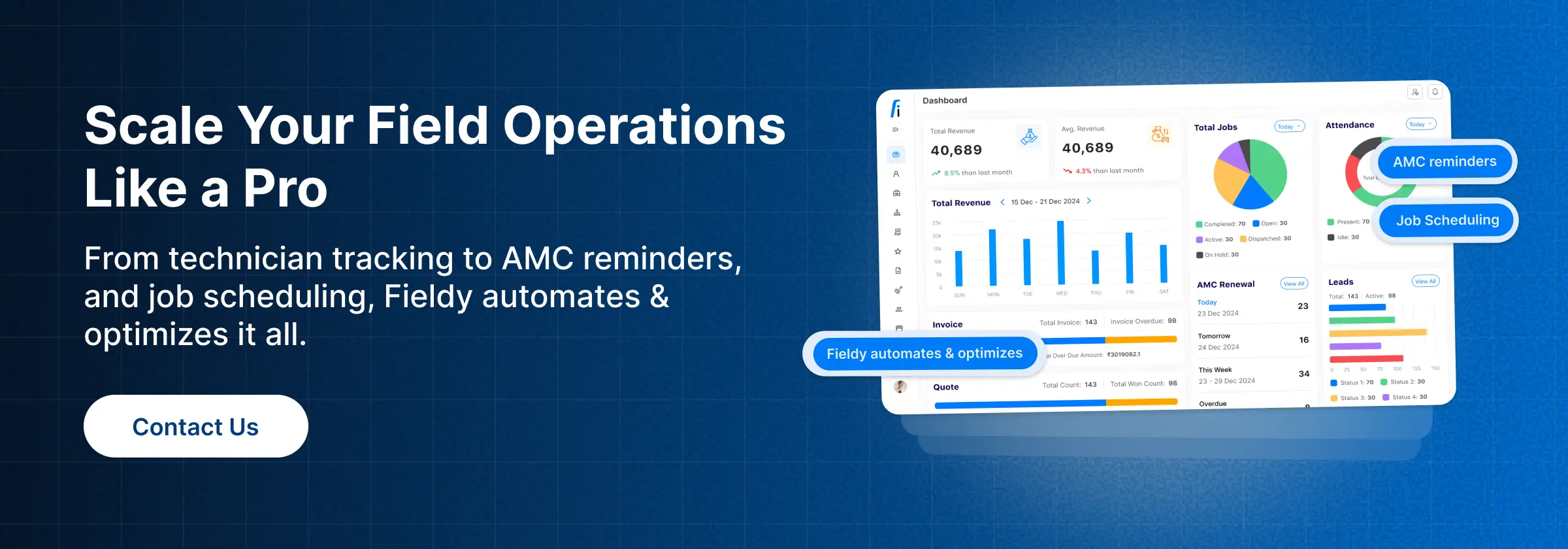
CTA Banner 2

These improvements also connect naturally to other FSM tools, such as lead management software, which bridges the gap between inquiries, active service, and follow-ups, creating a continuous, data-informed customer journey.

🔮 Future of Customer Service Experience in FSM — AI, Automation & Personalization

The global FSM software market is rapidly expanding, valued at around $5 billion in 2026 and projected to exceed $14 billion by 2035, growing steadily at 11–15% CAGR across regions. This surge highlights how automation and data intelligence are becoming vital to meeting rising customer expectations.

AI-driven predictive maintenance, automated scheduling, and chat-based support are revolutionizing field operations with real-time visibility and quicker resolutions. A cleaning company using Fieldy’s mobile FSM platform, for instance, achieved a 22% boost in first-time fix rates through better coordination and instant job data access. 

📊 Insight: Moreover, about three-quarters of field workers report rising customer expectations and a demand for personalized service, something Fieldy’s AI tools address through predictive insights, service history, and communication logs that help technicians deliver empathetic, tailored experiences.

In 2026 and beyond, the future of customer service experience in FSM will hinge on balancing automation with empathy, where technology streamlines service, and human connection sustains trust.

FAQs

What is customer service experience in field service management?

Customer service experience (CSX) encompasses how customers perceive every interaction with a service provider, from booking to completion. It represents the overall satisfaction, communication quality, and trust established throughout the relationship.

How does FSM software improve customer communication?

FSM tools improve communication by sending real-time updates, enabling live technician tracking, and automating notifications, ensuring customers always know what’s happening.

What is the main difference between customer service and customer experience?

Customer service is task-focused, addressing specific issues, while customer experience covers the emotional and relational aspects that define long-term loyalty.

What Makes a Great Customer Experience in Field Service for 2026

🏁 Introduction

💡 Why Great Customer Experience Defines Field Service Success in 2026

Customer experience (CX) has become increasingly crucial for business expansion, especially in field services where the competition is cutthroat. For companies offering HVAC, elevator maintenance, pest control, security systems, and facility management, CX includes every single interaction, from scheduling a technician to performing the service and collecting feedback after completion.

📊 Insight: What makes a great customer experience extends far beyond the technical service; it considers all interactions that take place along the journey, and they should be consistent, personalized, and transparent. Customers today expect to be contacted sometimes before an expected service, unless it is an emergency, timely updates on ongoing service, and the seamless delivery of agreed-upon service. The Service Council shares that more than 70% of customers switched providers after just one bad on-site experience, indicating the sobering consequences of poor CX. 

Such has been the evolution of FSM software owing to the growing recognition of experience-driven service. The FSM market is slated for a promising annual compounded growth rate of 11.4-14.5 percent over the coming years, highlighting a wide embrace of tools to nurture customer satisfaction. Such platforms as Fieldy allow service companies to monitor each touchpoint in one system, generating insights that align the operational performance with the expectations of customers. 

💰 Insight: In addition, companies focusing on CX reap real rewards from research evidence. 83% of companies that prioritize customer satisfaction bear testimony to higher revenue growth, showing a direct correlation between superior service experiences and financial performance. This brings increased customer retention, more repeat bookings, and firmer brand loyalty to field service providers.

🧱 The Core Pillars of a Great Customer Experience in Field Service

To truly understand what makes a great customer experience, it’s essential to examine the foundational pillars that influence customer perception and satisfaction in field service.

1️⃣ Convenience & Transparency

Convenience begins with an effortless booking process and continues through real-time updates and clear communication. FSM platforms like Fieldy enable customers to track service requests, receive live notifications, and know exactly when technicians will arrive. Multi-channel booking, including web portals and mobile apps, provides flexibility and ensures customers can schedule services at their convenience.

Transparency is equally critical. Providing estimated arrival times, expected duration, and updates on any delays helps build trust. Customers feel informed and valued, which reduces frustration and enhances satisfaction.

2️⃣ Communication & Responsiveness

Clear, timely communication is a cornerstone of CX. Customers appreciate updates regarding service status, technician location, or unexpected delays. Fieldy automates alerts and notifications, keeping customers informed without requiring manual follow-ups from technicians. Proactive communication demonstrates attentiveness and builds confidence in the service provider.

3️⃣ Consistency & Reliability

Consistency in service quality is essential for retaining customers. Metrics such as first-time fix rate (FTFR), on-time arrivals, and issue resolution speed provide measurable indicators of reliability. Field service companies that consistently meet or exceed these expectations establish a reputation for dependability, a key factor in long-term loyalty.

4️⃣ Personalization

Personalized experiences elevate customer satisfaction. Remembering customer preferences, previous service history, or AMC contracts allows technicians to tailor services to individual needs.

💡 Insight: According to recent industry surveys, 74% of mobile field workers report higher customer expectations than in previous years, with 73% observing a growing demand for personalized service. Companies leveraging Fieldy can integrate these details into service workflows, ensuring every interaction feels customized and attentive.

By combining these pillars with automated workflows and centralized data, Fieldy enables field service providers to consistently deliver superior experiences. Insights from how to measure customer experience in field service software (2026) help identify areas for improvement, ensuring the pillars are upheld across all customer interactions.

🌐 How Field Service Online Booking Software Enhances Customer Experience

The first touchpoint often shapes a customer’s service experience, and a complicated booking can lower satisfaction. Fieldy’s FSM-integrated online booking allows 24/7 scheduling, automated confirmations and reminders, and synced appointments with technician schedules.

🔔 Case Study:
An HVAC company using Fieldy saw a 30% rise in repeat appointments within six months due to convenience and timely reminders. Online booking also provides insights to track customer effort, analyze booking-to-service conversions, and identify peak-demand periods. Companies using the
best booking software in FSM or field service booking software can optimize schedules, anticipate demand, and improve both customer convenience and technician efficiency.

CTA Banner 1

🤝 Role of Customer Experience Management Software in Building Trust & Loyalty

Customer experience management (CXM) software allows FSM businesses to monitor satisfaction, loyalty, and service performance across all touchpoints. Platforms like Fieldy empower businesses to:

✅ Track real-time service progress

✅ Automate post-service feedback collection

✅ Integrate with CRM and invoicing for seamless communication

🔔 Case Study:

These insights help managers identify high-performing technicians, popular services, and areas needing improvement. For example, a facilities management company discovered through Fieldy that delays in a specific region caused a 15% dip in satisfaction scores. By reorganizing service routes and optimizing parts inventory, they not only restored their NPS to prior levels but also improved response times and overall operational efficiency.

The integration of employee productivity tracking software with CX management bridges the gap between workforce performance and customer satisfaction. By understanding both service quality and technician efficiency, companies can continually refine what makes a great customer experience, ensuring operational decisions translate into measurable improvements in customer loyalty.

⚙️ How Employee Productivity Impacts Customer Experience

Technician productivity is a critical factor in delivering high-quality CX. Engaged, efficient, and motivated employees ensure services are completed promptly and professionally, directly affecting customer satisfaction.

Fieldy’s employee productivity tracking software allows real-time monitoring of technician activities, automated task assignments, and alerts for idle time. Optimizing these workflows leads to more consistent service, fewer delays, and higher first-time fix rates.

For example, a plumbing service company using Fieldy reduced technician idle time by 20% and achieved a noticeable improvement in service speed and reliability. Customers reported higher satisfaction ratings, demonstrating a clear link between workforce efficiency and what makes a great customer experience.

Additionally, productive technicians free up capacity for additional service calls, allowing companies to meet growing demand without compromising quality. This aligns operational efficiency with CX goals, creating a sustainable cycle of performance and satisfaction.

🔮 Future of Customer Experience in Field Service – Smart, Predictive, and Personalized

The future of CX in FSM is intelligent, predictive, and hyper-personalized. Emerging trends in 2026 include:

🧠 Predictive Maintenance (IoT) – Detects issues before they escalate
🚗 AI-Powered Route Optimization – Ensures punctuality and reduced downtime
🔔 Personalized Service Reminders – Based on individual history and usage

Fieldy equips businesses to leverage these innovations, integrating analytics, automation, and customer-focused workflows. Mobile-first interfaces allow technicians to access service history, communicate in real-time, and provide instant updates to customers, enhancing transparency and satisfaction.

For example, HVAC companies following the HVAC Maintenance Schedule Checklist 2026 can automate reminders for filter replacements, service visits, or AMC renewals. This not only ensures timely maintenance but also creates a personalized experience that strengthens customer loyalty.

📈 Example: The rise of customer-centric technologies reflects industry trends, with 74% of mobile field workers noting higher customer expectations for personalized service. Adopting predictive and tailored CX solutions helps companies consistently meet these evolving demands.

By integrating predictive insights, AI tools, and real-time tracking, FSM businesses can continually refine what makes a great customer experience, ensuring each interaction adds tangible value for customers while improving operational efficiency.

🏆 Conclusion

Delivering excellent customer experiences in field service requires a balance of convenience, communication, consistency, and personalization. Fieldy enables businesses to:

✅ Simplify booking and scheduling

✅ Monitor satisfaction and loyalty in real time

✅ Boost technician productivity and reliability

✅ Implement predictive, AI-driven CX insights

Companies that understand what makes a great customer experience and integrate these strategies are better positioned to retain customers, encourage repeat business, and achieve sustainable growth in 2026 and beyond.

Deliver next-level customer experiences with Fieldy’s all-in-one field service management platform. Explore Fieldy’s Customer Experience Software today.

CTA Banner 2

How to Measure Customer Experience While Using a Field Service Customer Experience Software in 2026 [An Ultimate Guide]

🏁 Introduction

💡 Why Measuring Customer Experience Matters in Field Service

Customer experience (CX) is now central to business success, especially in competitive field services. From booking a technician to post-service follow-ups, every stage shapes customer perception. Industries like HVAC, elevator maintenance, pest control, and facility management show that consistent, positive experiences drive success, while a single poor interaction can push over 70% of customers to switch providers, according to a Service Council study.

That’s why understanding how to measure customer experience is crucial for field service companies in 2026. It allows them to identify weak points, improve technician performance, and ensure every service touchpoint strengthens customer trust and loyalty.

📊 Insight: FSM technology has been a catalyst in the heart of how companies measure experience and environment. By 2026, almost half of all employers in the service sector will have adopted FSM platforms, this figure being expected to soar to approximately 70% by 2027, each seeking improved customer relationships and operational transparency. 

The growing adoption underscores the value of experience-driven service. Fieldy’s customer experience management software enables companies to track satisfaction, response, and communication in one system, aligning customer sentiment with team performance.

For businesses using Field Service Management Software, CX measurement reveals not just what is done, but how well it is executed.

📈 Key Metrics to Measure Customer Experience in FSM

Understanding how to measure customer experience begins with identifying the right field service KPIs & metrics that truly capture what customers think and feel about your service. These metrics combine both data and emotion, quantifying satisfaction, loyalty, and operational excellence.

1️⃣ Customer Satisfaction (CSAT)

🗣️ CSAT surveys are among the most straightforward yet impactful CX indicators. They capture immediate customer feedback after service completion, providing direct visibility into technician performance and the quality of problem resolution.

2️⃣ Net Promoter Score (NPS)

📣 NPS gauges customer loyalty and advocacy. A high NPS reflects that customers not only trust your service but are willing to recommend it.

Case Study:

For instance, a pest control firm using Fieldy’s pest control software for automated NPS tracking saw a 22% increase in referrals after implementing post-visit feedback automation.

3️⃣ First-Time Fix Rate (FTFR)

🔧 FTFR measures how effectively technicians resolve issues during their first visit. Higher FTFR means reduced follow-ups, lower costs, and happier customers. Industry analysis shows that every 10% increase in FTFR can raise customer retention by up to 12%, underlining how service precision fuels satisfaction.

4️⃣ Response and Resolution Time

⚡ In 2026, customers expect swift action. Tracking average response and resolution times helps FSM leaders understand communication gaps and optimize technician allocation for faster turnaround.

5️⃣ Customer Retention and Repeat Bookings

🔁 Strong CX directly correlates with loyalty. By monitoring repeat bookings and renewal rates, businesses gain a clear view of long-term satisfaction and service consistency.

📊 Fieldy Dashboard: Fieldy automates KPI tracking and visualization through intuitive dashboards, combining both quantitative metrics (CSAT, NPS) and qualitative insights (customer sentiment).

This unified approach gives businesses a holistic picture of experience quality, aligning perfectly with strategies discussed on how to improve customer experience for FSM industries.

🧠 Role of Customer Experience Software in FSM Measurement

A modern customer experience software functions as the analytical backbone for service operations. It consolidates interactions from multiple touchpoints, bookings, communications, technician visits, and feedback, creating a full-cycle visibility of the customer journey.

Fieldy’s integrated FSM platform makes this process seamless by offering:

  • Real-time visibility into ongoing jobs and technician performance.
  • Automated feedback collection after every service completion.
  • Unified CRM and service history to keep track of customer needs and patterns.

These insights empower teams to recognize trends, identify recurring pain points, and take proactive measures.

💡 Case Study:

For instance, a facilities management company used Fieldy’s dashboards to uncover regional delays that led to a 15% drop in satisfaction scores. After optimizing routes and inventory, they restored their NPS to previous levels and improved response times.

FSM platforms with employee productivity tracking software further connect workforce efficiency with CX results, ensuring technician performance directly drives customer satisfaction, a hallmark of the best customer experience management software in FSM today. 🔻🔻🔻

CTA Banner 1

🌐 Using Online Booking Software to Enhance and Measure CX

Customer experience begins long before a technician arrives. It starts at the booking stage, where ease, accessibility, and clarity shape first impressions. A smooth booking process sets the tone for trust and satisfaction.

Integrating field service online booking software with CX tracking tools allows companies to understand how customers engage before, during, and after scheduling.

🔍 Key benefits include:

  • 📲 Tracking customer effort: Measures how intuitive and simple the booking flow is.
  • ⏱️ Logging response times: Identifies how quickly businesses confirm bookings or respond to inquiries.
  • 📈 Monitoring booking-to-service conversion rates: Helps identify when and why potential appointments drop off.

💡 Case Study: An HVAC service provider using Fieldy’s booking module discovered through data analysis that cancellations were unusually high on weekends. By adjusting technician availability and optimizing confirmation messages, they achieved a 40% reduction in cancellations and improved booking satisfaction scores by 25%.

This kind of insight demonstrates how tools like field service scheduling software and best booking software for small businesses in FSM can do more than simplify scheduling; they actively enhance CX visibility and improvement.

💬 How to Collect and Analyze Customer Feedback in FSM

Measuring CX goes hand in hand with collecting consistent, real-world feedback from customers. Without structured data, decisions are often based on assumptions rather than evidence.

1️⃣ Multi-Channel Feedback Collection

Businesses can capture insights from several sources, post-service surveys, follow-up emails, SMS requests, and app-based ratings. Each method adds another dimension to understanding customer perception.

AI-powered sentiment tools embedded in FSM platforms analyze tone, language, and intent, helping teams distinguish between satisfied, neutral, and dissatisfied customers.

2️⃣ Real-Time Feedback Integration

Fieldy’s FSM software integrates customer responses directly into their profiles. This means that every feedback entry becomes part of the overall service record, helping teams correlate satisfaction with specific job details or technician behavior.

Example:

A pest control business that linked feedback data with its lead management software. The integration enabled managers to quickly identify at-risk customers,  those with neutral feedback, and follow up with service discounts or priority appointments. The result? A 25% boost in repeat service subscriptions within a single quarter.

3️⃣ Turning Data into Insights

When paired with job scheduling software in FSM, businesses can pinpoint performance patterns and address operational bottlenecks before they affect CX. Moreover, 83% of companies that prioritize customer satisfaction report stronger year-over-year revenue growth, proving that CX excellence directly influences financial performance.

By analyzing customer sentiment and trends in real time, FSM organizations can build a customer-first culture that consistently fuels profitability.

🏆 Conclusion

Turning Customer Insights into Service Improvements with Fieldy

The key to mastering how to measure customer experience lies not only in gathering data but in transforming it into actionable insights. Each metric and feedback point should drive smarter scheduling, targeted training, and improved engagement.

Service businesses can enhance CX by:

  • 👨‍🔧 Training technicians in areas where ratings are low.
  • 🗺️ Optimizing routes and schedules to cut wait times and boost efficiency.
  • 💌 Personalizing communication with tailored reminders and follow-ups.

Fieldy’s automated workflows simplify this process, combining technician analytics, feedback tracking, and scheduling optimization into a single ecosystem. For instance, an elevator maintenance provider used Fieldy to pinpoint repeat issue zones and train staff accordingly, achieving a 33% rise in satisfaction scores and a sharp drop in rework within just one quarter.

As CX technology advances, AI, IoT, and predictive analytics are reshaping how FSM companies anticipate and prevent service dissatisfaction. Adopting field service optimization and route optimization systems helps set new benchmarks for responsiveness and reliability.

Guides like the HVAC Maintenance Schedule Guide 2026 also show how smart scheduling directly supports long-term customer satisfaction.

In essence, measuring CX is an ongoing journey—one that builds trust, loyalty, and revenue in the digital-first service world.

👉 Ready to deliver next-level customer experience? Explore Fieldy’s Customer Experience Management Tools today.  🔻🔻🔻

CTA Banner 2

How to Improve Customer Experience for Industries That Use FSM Software

🏁 Introduction:

💎 Why Customer Experience Is the New Competitive Edge in Field Service

Today, in the highly competitive service industry, customer experience is the factor that either chains or liberates a field service business. Be it an HVAC expediting an emergency call, an elevator firm ensuring uptime, or a pest control doing scheduled inspections, every touchpoint is indeed a brand perception.

In service, field customers experience the quality of interaction between the customer and the service provider from the first appointment to the last follow-up after services have been rendered. The modern customer is no longer interested in quick service alone; he wants transparency, accuracy, and reliability. The competition for fieldwork is not only in what players have to offer but how they deliver it.

This was a perfect setup for the software of Fieldy FSM taking over. It puts activities into one large bucket, like dispatching, invoicing, tracking of technicians, etc., minimizing delays to the service teams to give the customers a seamless journey. Along with that, when coupled with field service optimization and route optimization, it leads to faster and more efficient job completions, hence increasing service satisfaction and retention.

⚠️ Common Customer Experience Challenges in Field Service

For a field service business, customer retention is a major concern, and most of these businesses can put their CX at a disadvantage. Many issues arise out of outdated systems and fragmented communication processes or sheer manual scheduling.

1️⃣ Delays and Miscommunication

Displeasure begins when technicians do not show up on time or fail to update customers. “Studies have pointed out that, more than price competitiveness, punctuality, and clear communication are values customers uphold,” making it imperative to be reliable to ensure operational success.”

2️⃣ Manual Work Is Inefficient

With manual scheduling, conflicts in appointment timings are made, data can go missing, and information exchange between dispatchers and field workers sometimes does not transpire smoothly. This has always been the scenario for tasks falling between the cracks without automation, very poor service experiences.

3️⃣ Absence of Real-Time Visibility

In the absence of live intelligent tracking or updates on field service scheduling, there remains a common view shared by customers, tagging service technicians, as there is uncertainty about arrival time and job progress. This barrier then disquiets integrity and discourages engagement for repeats.

In the end, it boils down to such issues having been created by two-based scenarios of poor visibility and unconnected operations. Deployment of automation and transparency in real time is exalted as the backbone for an unrivalled field service experience-where internal work efficiency and customer delight are raised side by side.

💡 Automation + real-time visibility = higher efficiency and better CX.

This directly connects to employee productivity in field service, where well-equipped teams not only work smarter but also create smoother, more reliable customer interactions.

🧠 Using FSM Software to Improve Customer Experience

FSM software is transforming how field service companies operate by integrating scheduling, communication, and performance tracking into one intelligent system.

1️⃣ Unified Operations

By consolidating scheduling, dispatching, invoicing, and communications, tools like Fieldy’s FSM software remove the friction of using multiple disconnected systems. This ensures every team member,  from office staff to technicians, works with the same real-time data.

2️⃣ Real-Time Technician Tracking

GPS-enabled tracking and instant updates keep customers informed about technician arrival times and job status. This transparency fosters trust and eliminates uncertainty.

💡 Insights: Interestingly, field service companies that achieve a first-time fix rate (FTFR) of over 70% see customer retention levels soar up to 86%, underscoring how operational efficiency directly fuels lasting loyalty.

3️⃣ Quality Control and Accuracy

Through digital job cards and checklist verification, FSM tools ensure that technicians deliver consistent, accurate results. Research from Field Technologies Online indicates that businesses using FSM software see a 30% increase in their first-time fix rate, proving its measurable impact on customer experience.

A well-orchestrated system also strengthens overall field service management workflow, helping businesses maintain consistent quality and response times across multiple service locations.

🌐 Online Booking Software – Features Required

Convenience has become the heart of modern customer experience. Clients today expect the ability to book, reschedule, or cancel appointments instantly,  without waiting for a phone call or manual confirmation.

1️⃣ Simplified Booking and Rescheduling

Fieldy’s Online Booking Software gives customers the freedom to schedule services directly from their devices. It reduces administrative overhead for service teams and gives customers real-time access to available time slots.

2️⃣ Automated Confirmations and Smart Reminders

Instant confirmations, automated reminders, and dispatch notifications not only save time but also create a sense of reliability and organization.

Implementing FSM solutions like Fieldy can reduce customer complaints by up to 30% while boosting positive reviews by nearly 40%, driven by smarter scheduling, faster updates, and transparent communication.

🧾 Case Studies:

  • 🔧 An HVAC business managing emergency cooling repairs during peak summer. 
  • 🏢 An elevator maintenance firm is automating recurring inspection schedules. 
  • 🐜 A pest control company is organizing quarterly visits for loyal customers.

For small– and mid-sized service providers, adopting the best booking software for small businesses in FSM ensures operations remain efficient while customers enjoy frictionless, on-demand service access.

Try Fieldy’s Customer Experience Management Software Today ⏬⏬⏬

CTA Banner 1

💬 Personalization and Proactive Communication Through FSM Tools

Personalization and proactive engagement are the hallmarks of exceptional customer experience. Customers prefer companies that understand their needs, anticipate service requirements, and maintain consistent communication.

1️⃣ Data-Driven Personalization

Integrated CRM systems within FSM software help businesses record customer details, service history, and preferences. For instance, an electrical service provider can assign the same technician to a returning customer who values familiarity, ensuring a personalized touch.

2️⃣ Proactive Maintenance and Renewals

Fieldy’s automated reminders for AMC renewals and preventive maintenance visits prevent service gaps. Proactive engagement shows attentiveness,  reinforcing that the company values the customer’s time and trust.

3️⃣ Empowered Technicians, Better Service

Technicians equipped with prior service records can deliver faster, more accurate solutions. This readiness enhances first-time fix rates and showcases professionalism during on-site interactions.

Modern customer experience software in FSM bridges the gap between operational efficiency and personalization, while contract management tools in field service ensure every client relationship remains transparent and ongoing.

🚀 Readiness = better first-time fix and happier customers.

📊 Measuring and Optimizing Customer Experience Continuously

Sustaining customer satisfaction requires consistent evaluation. With FSM software, businesses can monitor performance metrics and make data-backed improvements to service delivery.

1️⃣ Key Customer Experience Metrics

Tracking KPIs such as:

  • 🧰 First-Time Fix Rate (FTFR)

  • ⏱️ Service Turnaround Time

  • 😊 Customer Satisfaction (CSAT)

  • 📣 Net Promoter Score (NPS)

  • 👷 Technician Utilization Rate

These indicators help identify where operations excel and where adjustments are needed.

2️⃣ Continuous Feedback Collection

Digital feedback forms and post-service surveys embedded in Fieldy provide immediate insight into how customers perceive each interaction. This information feeds directly into performance analytics, creating a continuous improvement loop.

3️⃣ Data-Driven Refinement

With Fieldy’s analytics dashboard, businesses can detect trends, seasonal demand patterns, and recurring service issues. Regular performance analysis, coupled with updated field service checklists for 2025, helps standardize quality while maintaining compliance and efficiency.

By understanding these insights and adapting accordingly, service providers master how to improve customer experience and translate that knowledge into sustained business growth.

💡 Continuous learning drives continuous loyalty.

🏆 Conclusion:

Delivering Exceptional Customer Experience with Fieldy

Customer expectations have evolved; they demand clarity, timeliness, and trust. For industries like HVAC, plumbing, pest control, and elevator maintenance, this means that operational excellence must go hand in hand with customer-centric service delivery.

Fieldy’s FSM software empowers businesses to achieve this balance by automating scheduling, tracking, and communication, all while capturing valuable customer insights. From streamlined booking experiences to proactive CRM engagement, Fieldy simplifies operations and enhances every stage of the customer journey.

By focusing on efficiency, transparency, and personalization, businesses not only strengthen their brand image but also unlock the secret of how to improve customer experience, setting a foundation for loyalty, retention, and growth in 2025 and beyond. 

Want to enhance your customer experience and streamline field operations?

Try Fieldy’s FSM Software today. ⏬⏬⏬

CTA Banner 2

What is the Best Booking Software for Small Businesses in FSM? Masterclass for 2026

🏁 Introduction

Running a field service management (FSM) business on a small level in 2026 entails much more than just technical service capabilities. Customers now demand easy booking, instant updates, and dependable delivery service. For small companies, even minor errors, such as double booking or missing an appointment, can result in lost business and revenue. 

Consequently, the best booking software solutions for small business operations are an overnight must-have. Such solutions facilitate appointments, reduce no-shows, and provide managers with real-time reports on technician availability. Instead of juggling manual spreadsheets or making phone confirmations, they may automate bookings, reminders, and dispatching processes-all-time and cost-saving.

The impact, as highlighted by recent industry findings, FSM software solutions with mobile capabilities help reduce no-shows and scheduling errors.

💡 Insights: Additionally, companies using booking software reported a 40% increase in customer satisfaction, largely due to timely service, automated reminders, and improved communication.

For smaller service teams, this advantage often determines whether the business grows or struggles to keep up.

📊 What Defines the Best Booking Software for Small Businesses?

For smaller FSM providers, choosing the right platform is about balancing usability with capability. Advanced tools are valuable, but if the software is too complex or costly, it won’t deliver results.

🧭 Criteria 💡 Why It Matters
Ease of Use Teams without dedicated IT staff need a simple, intuitive setup.
Affordability Transparent, flexible pricing ensures growth without financial strain.
Scalability The platform should expand as customer demand increases.
Integration Must connect with CRM, invoicing, and contract management tools.
Mobile-First Enables technicians to update status, track jobs, and access bookings in the field.

When integrated with scheduling and workforce management tools, these features not only streamline daily operations but also allow managers to allocate technicians more efficiently, minimize idle time, and ensure that jobs are completed promptly. 

This combination reduces operational downtime, prevents overbooking, and helps teams meet service deadlines consistently, ultimately improving both productivity and customer satisfaction.

🧩 Top 5 Best Booking Software for Small Businesses in FSM (2026 Edition)

1️⃣ Fieldy – Top Rated

Considered by many small-business FSM teams to be the best booking software, Fieldy puts several functions under one roof. It was created for the service provider so that bookings are connected directly to invoicing, contracts, and technician dispatching.

💡 Key Benefits:

🧾 Case Study: A plumbing business in the UK offers a pretty clear example: Before the change, managers spent at least 20 hours per week fixing scheduling errors. Double bookings and missed visits completely ruined client relations.

💡 Key takeaways: After changing to Fieldy’s field service booking software, administrative work was reduced by 35%, scheduling clashes diminished significantly, and workload allocation among technicians was balanced much better. Complaints drastically dropped, while customer retention gained respect.

This just goes to prove why Fieldy is among the top choices with verifiable reasons: Equity price benefits the companies while offering full features so that smaller FSM companies can maintain growth without affecting service quality.

Try Fieldy Now▼▼▼

CTA Banner 1

2️⃣ Jobber

Jobber is another popular platform among service-based small businesses, offering a mix of booking, invoicing, and client management tools.

✅ Pros:

  • User-friendly scheduling and invoicing.
  • Clean, professional customer communication.

⚠️ Cons:

  • Pricing rises as team size increases.
  • Limited customization compared to Fieldy.

Many businesses weighing their options often evaluate Fieldy vs Jobber to determine whether they need a more complete FSM solution or just a scheduling assistant.

3️⃣ Housecall Pro

Housecall Pro stands out for its strong mobile-first design, which appeals to teams that rely on technicians updating jobs in the field.

✅ Pros:

  • Excellent mobile usability.
  • Streamlined quote-to-invoice workflow.

⚠️ Cons:

  • Premium features are locked behind higher plans.
  • Less suitable for multi-branch or franchise setups.

Because of this, many small businesses compare Fieldy vs Housecall Pro when deciding between broader FSM integration and simple booking tools.

4️⃣ Zoho FSM

Zoho FSM integrates deeply with the Zoho ecosystem, making it ideal for companies already using Zoho CRM, Zoho Books, or Zoho Inventory.

✅ Pros:

  • Smooth integration with other Zoho apps.
  • Strong analytics and reporting.

⚠️ Cons:

  • Can be complex for non-Zoho users.
  • Not as intuitive as lightweight alternatives.

Firms already using Zoho products often weigh Fieldy vs Zoho FSM to see if they should stay within the Zoho ecosystem or switch to a platform designed exclusively for field service.

5️⃣ ServiceTitan

ServiceTitan is a widely known service industry solution, though it is typically better suited to larger businesses than smaller FSM operators.

✅ Pros:

  • Advanced analytics and customization.
  • Widely recognized across large-scale service industries.

⚠️ Cons:

  • Pricing and setup can overwhelm smaller companies.
  • Lacks FSM-specific AMC features.

Smaller providers often run a Fieldy vs ServiceTitan analysis to see whether they require enterprise-scale complexity or a leaner, more affordable solution.

💼 Benefits of Booking Software for Small FSM Businesses

The business case for booking software is clear. By automating appointment handling, companies can eliminate inefficiencies and improve profitability.

💡 Key benefits include:

  • Improved customer experience: Clients appreciate instant confirmations and real-time updates.
  • Fewer no-shows: Automated reminders reduce missed appointments significantly.
  • Smarter dispatching: Jobs are assigned based on technician location and availability.
  • Data-driven insight: Businesses gain clarity on peak demand, top-performing staff, and revenue patterns.

💡 Insights: Recent reports show that FSM businesses using mobile-first booking solutions reduce scheduling errors by 20–35%.  These outcomes highlight how technology directly enhances both operational efficiency and client loyalty.

🥇 Why Fieldy Leads the Way

While several platforms provide booking features, Fieldy offers a more holistic approach. Its functionality spans across:

  • Online booking management
  • AMC contract scheduling
  • Invoicing automation
  • CRM and lead tracking
  • Asset and technician management

💡 Inference: Because of its pricing flexibility, intuitive design, and mobile-first experience, Fieldy is uniquely positioned as the best booking software for small business FSM teams. From HVAC contractors handling seasonal demands to pest control services managing repeat visits, Fieldy adapts to different service verticals without unnecessary complexity.

Its integrations also align naturally with broader needs like field service optimization and workforce scheduling efficiency, making it a future-ready platform.

🧠 Best Practices for Small Businesses Using Booking Software

To get maximum ROI from booking platforms, FSM businesses should:

  • Standardize appointment durations: Add buffer times to avoid overlaps.

  • Offer multi-channel booking: Let clients schedule online via websites and social media.

  • Leverage automated reminders: Reduce cancellations with SMS and email confirmations.
  • Train staff and technicians: Ensure the mobile app is fully utilized in the field.

🚀 Conclusion

Smarter Bookings for Stronger Growth

In 2026, booking efficiency directly shapes customer loyalty and profitability for FSM businesses. Manual processes leave room for error, but modern booking platforms eliminate inefficiencies and improve overall service quality.

By implementing the best booking software for small business operations, owners can ensure

  • fewer scheduling errors,
  • faster technician response, and
  • better customer experiences.

Among available solutions, Fieldy stands out as the most complete, affordable, and future-ready option, enabling small FSM businesses to grow sustainably while keeping service quality intact. 

Want a booking solution that grows with your small business? Try Fieldy today. ▼▼▼

CTA Banner 2

❓FAQs – Booking Software for Small Business FSM Providers

What is the best booking software for small business FSM providers?

The best solution is one that balances affordability with FSM-specific tools. Fieldy is a leading choice in 2025 because it combines booking, invoicing, AMC tracking, and technician management.

How do booking platforms reduce no-shows?

By sending automated reminders, enabling self-service booking, and offering real-time technician tracking, they reduce cancellations and delays.

Can small businesses afford FSM booking tools?

Yes. Platforms like Fieldy offer flexible, per-user pricing, making them accessible to even the smallest teams.

What features should FSM businesses prioritize?

Mobile-first booking, CRM integration, contract tracking, invoicing, and dispatch optimization are key features to look for.

How does mobile access improve booking efficiency?

Mobile-first booking tools allow technicians to view schedules, accept jobs, and update status in real time, reducing delays and miscommunication.

What is the Best Booking Software for Job booking in an FSM business for 2026?

🏗️ Introduction 

📅 The Booking Challenge for Field Service in 2026

For various field service industries, such as HVAC, plumbing, electrical, elevator, and security, scheduling is the backbone of delivering services smoothly. Growth has only sustained the demand for instant booking, real-time confirmations, and 24/7 availability, as far as customer expectations are concerned, in 2026. Yet, manual scheduling methods continue to create problems: overlapping appointments, last-minute cancellations, and no-shows.

Studies show that a narrow scheduling technique can result in up to 15% of the service providers’ annual revenue being lost due to errors and missed bookings. The creation and deployment of great FSM-based booking software is the answer to the problem. These software systems help to cut down unnecessary human errors, boost customer satisfaction, and enhance customer loyalty over time.

⚙️ What Makes a Booking Software “Best” in 2026? Key Features to Look For

When determining what qualifies as the best solution, functionality is key. Below is a snapshot of essential features FSM businesses should consider:

🚀 Feature 💡 Why It Matters in FSM 📘 Example in Action
⏰ Real-time booking Allows customers to schedule anytime Customer books an HVAC service at night
🗓️ Calendar sync & conflict detection Prevents double-bookings A technician isn’t assigned two jobs at once
🔔 Automated reminders Cuts down no-shows SMS/email notifications to clients
📱 FSM Mobile app for technicians Access from the field Tech receives booking updates instantly
🧾 Job order & invoice conversion Saves admin time Booking becomes an invoice automatically
⚙️ Asset & inventory integration Ensures readiness Parts are pre-checked for jobs
🌍 Multi-location & franchise support Ideal for scale A franchise coordinates across 15+ sites
💲 Transparent pricing Fits all business sizes Per-user/month models for SMBs or enterprise tiers

💡 Industry insight: Service providers with automated booking tools see 25–30% fewer missed appointments compared to teams still using spreadsheets or manual schedulers.

🧭 Types of Booking Software Models

🏷️ Model 📖 Description ✅ Pros ⚠️ Cons
🛠️ FSM-specific booking tools Built for service industries Tailored workflows Slightly higher investment
📅 Generic appointment apps Basic scheduling Affordable & simple Lack of FSM depth
🏗️ End-to-end FSM platforms Full integration Handles contracts, assets, & invoicing Higher learning curve
🔌 Plugins or add-ons Attach to CRM/ERP Low cost Limited scalability

Case example: A mid-sized elevator company in Toronto moved from a generic app to an FSM-focused solution and reduced reschedules by 40% in under three months, thanks to automated calendars and reminders.

🥇 Top Booking Software Options for 2026 (Field Service Focused)

1️⃣ Fieldy – Most Preferred

Considered the first among the best booking software for field service management (FSM) teams by 2026, Fieldy differs from generic appointment tools in that it is a tool dedicated entirely to FSM businesses in terms of job booking, scheduling, contract management, and invoicing integrated into a single platform. This eliminates the juggling of different systems and ensures that all bookings have a direct link to the workflows, technician availability, and relevant customer data. 

✅ Pros ⚠️ Cons
📍 Real-time bookings with technician mapping:
Customers can book appointments online, and the system instantly assigns the nearest qualified technician.
🔄 Limited advanced integrations: The platform is still expanding its support for highly customized third-party tools, which may affect complex enterprise setups.
🧾 Seamless job-to-invoice conversion: Once a job has been completed, it automatically converts to an invoice, eliminating double data entry and saving admin time.
🔔 Integrated notifications and technician tracking: Both customers and technicians receive synchronized updates, minimizing no-shows and improving process visibility.


Case Study Example:

A UK plumbing company showed how Fieldy transforms operations. Earlier, they spent over 20 hours a week fixing scheduling errors, facing double-bookings, missed appointments, and frequent complaints. After adopting Fieldy, admin time fell by 35%, scheduling issues dropped sharply, and technicians managed workloads more efficiently.

This improvement boosted productivity and response times, proving why Fieldy is among the most preferred booking software in FSM, integrating core booking with operational tools to help businesses scale without losing service quality. 

CTA Banner 1

2️⃣ Housecall Pro

Housecall Pro continues to be popular among small contractors. It’s known for its straightforward booking and invoicing system.

✅ Pros ⚠️ Cons
👍 Easy to use: The platform’s intuitive interface ensures quick adoption by field teams and office staff. 🔌 Limited integrations: May not fully support complex workflows required by larger enterprises.
🌐 Customer-friendly portals: Provide clients with transparent access to job updates, invoices, and communication tools.


💡 Insights: When comparing Fieldy vs Housecall Pro, many businesses note that Fieldy provides greater scalability for multi-location teams, whereas Housecall Pro suits smaller service contractors.

3️⃣ Jobber

Jobber is well-regarded for its clean interface and user-friendly scheduling.

✅ Pros ⚠️ Cons
💰 Strong quoting and invoicing features: Simplifies pricing, billing, and job cost tracking for faster payments and accurate records. 🏢 Limited enterprise capabilities: May lack advanced scalability or customization needed for large, multi-branch organizations.


💡 Insights: A Fieldy vs Jobber comparison often shows Jobber as ideal for small to mid-sized providers, while Fieldy integrates more deeply with contracts and assets.

4️⃣ ServiceTitan

ServiceTitan remains a premium choice for enterprise-level field service businesses.

✅ Pros ⚠️ Cons
📈 Advanced analytics, automation, and multiple integrations: Enable data-driven decision-making, streamlined workflows, and seamless connectivity across tools. 💸 Higher price point and steeper learning curve: May require more onboarding time and investment, especially for smaller teams.


💡 Insights: In a Fieldy vs ServiceTitan comparison, the trade-off is usually complexity and cost versus simplicity and affordability.

5️⃣ Zuper

Zuper is gaining attention for its AI-powered scheduling and real-time technician collaboration.

✅ Pros ⚠️ Cons
🚀 Strong mobile features and smart scheduling: Enable technicians to manage tasks efficiently on the go while ensuring optimized job allocation. 🧩 May require onboarding for full utilization: Teams might need brief training sessions to leverage all mobile and scheduling features effectively.

💡Insights: Looking at Fieldy vs Zuper, Zuper excels at intelligent job allocation, while Fieldy offers more comprehensive FSM workflow coverage.

6️⃣ PandaDoc

While traditionally known as a document automation platform, PandaDoc has become a strong option for field service companies needing integrated quoting and booking. It provides automated workflows, mobile-friendly interfaces, and built-in e-signatures, starting at $35 per user/month.

Industry note: PandaDoc’s flexibility makes it suitable for both small contractors and enterprise service firms managing high volumes of customer documentation.

7️⃣ Quotient

Quotient is highly regarded by small businesses that need simple and effective booking and quoting. With a G2 and Capterra rating of 4.7/5, it offers one-click acceptance, quick setup, and streamlined communication. Pricing begins at $28 per user/month, making it an attractive option for contractors with tighter budgets.

📊 How Booking Software Impacts FSM Efficiency?

The real value of adopting the best booking software lies in efficiency gains across the business.

  • Reduced no-shows: Automated reminders can lower missed appointments by 30–40%.
  • Resource optimization: Jobs are assigned based on technician proximity and availability.
  • Customer satisfaction: Transparent booking improves trust, especially when paired with customer experience software that enhances communication.
  • Data-driven insights: By analyzing booking patterns, companies can predict high-demand periods and optimize scheduling.

💡 Stat insight: FSM businesses using digital booking tools have reported a customer retention increase of up to 18%, thanks to better communication and service transparency.

🧭 Best Practices for Choosing & Using Booking Software

  • Test before committing: Use free trials or demos to assess fit.
  • Create buffer times: Avoid overlapping commitments with standard booking windows.
  • Automate reminders: Reduce cancellations with SMS/email alerts.
  • Train both staff and technicians: Adoption works best when the whole team is confident using the tool.
  • Measure success: Track KPIs & metrics like technician utilization and conversion rates.

When combined with contract management software, bookings become more efficient as all contract details flow seamlessly into technician assignments. Likewise, companies that focus on employee productivity improvements find booking automation reduces wasted admin time.

🏁 Conclusion

⭐ Why Fieldy Stands Out as the Best Booking Software for Field Service

For 2026, the best booking software isn’t just about scheduling appointments. It underpins workforce efficiency, revenue growth, and customer satisfaction.

Fieldy offers an all-in-one FSM experience, connecting booking, scheduling, asset management, contract renewals, and invoicing in a single platform. With real-time updates and a mobile-first design, it adapts equally well for independent contractors and multi-location enterprises.

Looking for booking software that simplifies scheduling, reduces admin work, and improves service delivery?

Fieldy’s booking and scheduling platform is designed to meet field service demands in 2026. 

CTA Banner 2

❓FAQs

What is booking software in field service?

It’s a tool that allows customers to book services in real time, integrates calendars, and transforms bookings into job orders or invoices.

How does booking software cut down no-shows?

By automating reminders and confirmations, customers are less likely to miss appointments.

What’s the difference between generic booking apps and FSM platforms?

Generic apps focus on scheduling only, while FSM-specific platforms integrate contracts, assets, and workforce management for a complete operational workflow.

What Is the Best Quoting Software for Field Servicing in 2026? An Ultimate Guide

📝 Introduction

Estimating is not merely a matter of numbers for the field service industry; it is all about accuracy, speed, and building trust. Poorly prepared and error-prone quotes almost always result in forgoing potential jobs and wasting technician time, thereby cutting substantially into their margins.

Facts💡: For this reason, more companies have been seeking the best quoting software to optimize the full quoting process. Field service companies claim that implementing automated solutions leads to a 35% drop in time spent on administrative tasks for quote creation from having available template libraries and auto-calculation features.

In 2026, quoting tools will be a must-have for any business that wants to remain competitive within this digital-first environment. Beyond that, as field service operations become more complicated in aspects of service delivery across locations, various service offerings, and stringent compliance, digital quoting solutions help maintain uniformity, consistency, and traceability across teams.

🚀 Key Features to Look for in Quoting Software for Field Service

Not all platforms, however, deliver the same benefits and features, so determining priorities helps businesses in selecting the right quote software for their needs. The most critical features include:

  • ⚡ Instant Quoting: From the office or field, allowing technicians to respond immediately to customer requests.
  • 📑 Customizable Templates & Pricing: For parts, labor, and margins to maintain consistency and accuracy.
  • 📎 File and Image Attachments: Attachments, along with terms and conditions for full client transparency.
  • ✏️ Edit, Clone, & Resend them: Anything to edit repeats or modifications to save the updates on working estimates.
  • 🖊️ E-Signatures: Digital acceptance with e-signature or client portals encourages fast approvals.
  • 🔄 Convert Quote->Invoice->Jobs: Convert from the quote to a job so that work orders and invoices are generated automatically when clients accept.
  • 📊 Tracking: Status tracking of quote processes, i.e., draft, sent, viewed, approved, or expired.
  • 🎛️ Flexibility: Pricing flexibility and versioning to accommodate changes without losing history.

Furthermore, some advanced quoting software (like Fieldy) now employs AI to recommend optimal pricing based on historical data, job type, and market trends-they help technicians in wiring quotes profitably without underquoting.

💡 Facts: Speed is important too: With digital quoting in place, win rates increase by up to 20%, as customers appreciate faster and more professional proposals. 

Integrating quoting tools with field service scheduling software or CRM systems also ensures that customer data, job history, and asset information are readily available when creating accurate proposals, reducing time spent cross-checking files or records.

💰 How Quoting Software Improves Field Service Workflow & Profitability

The right quoting system can transform how service businesses operate, impacting everything from revenue to customer experience.

  • 🏆 Shorter sales cycles help win more jobs. A contractor using automated quoting reported a 20% higher close rate because they could respond faster with polished proposals.

  • 🛡️ Fewer errors protect profit margins. Auto-calculations reduce underquoting, while standard pricing rules ensure consistency across technicians.

  • 💎 Professional branding builds trust. Customers receiving structured quotes with clear pricing, photos, and attachments are more likely to approve quickly.

  • ⏱️ Less admin work frees resources. Linking quoting to job creation and billing means fewer manual handoffs.

  • 📈 Better visibility improves strategy. Managers can track conversion ratios, analyze lost vs won quotes, and adjust pricing accordingly.

For example, a mid-sized HVAC company integrating price quote software into workflows cut quoting time in half, freeing technicians to focus on service delivery rather than paperwork. Pest control companies adopting digital quoting tools have reported faster approval times and reduced follow-up calls for clarifications. Combining quoting with field service contract management ensures that every estimate aligns with contractual obligations, avoiding disputes and strengthening customer trust.

🏆 Top Quoting Software Options for Field Servicing in 2026

There’s no shortage of choices on the market. Here are some of the top-rated options for 2026:

1️⃣ Fieldy – Most Preferred 🌟

  • ✅ Pros: Rapid quote creation, reusable templates, photo attachments, conversion to job/invoice, filters, e-sign support, and editing features.

  • ❌ Cons: Newer to the market compared to some competitors.

  • 🎯 Best for: Companies seeking speed, accuracy, and integration with broader FSM processes. 🔽🔽🔽

CTA Banner 1

2️⃣ BuildOps

  • ✅ Pros: Strong catalog integration for parts and pricing, real-time collaboration between office and field, and quote tracking.

  • ❌ Cons: Designed with enterprise needs in mind; may be costly for smaller teams.

3. FieldBoss

  • ✅ Pros: Tailored for HVAC and elevator industries, includes templates, and supports conversion of quotes to work orders and invoices.

  • ❌ Cons: Can be complex to configure and requires significant onboarding.

4. ServiceBox

  • ✅ Pros: Drag-and-drop templates, simple tracking, intuitive workflows.

  • ❌ Cons: Best for small to mid-sized service contractors; less suited to large enterprises.

5. Klipboard

  • ✅ Pros: Strong branded templates, line-item breakdowns for parts and labor, digital approval options.

  • ❌ Cons: Geared towards small teams; lacks enterprise-grade scalability.

These tools demonstrate how the right quoting software can scale with business needs. For instance, multi-location HVAC businesses that integrate quoting with field service invoicing software can ensure technicians receive the most updated job information along with the quote, invoices, etc, reducing delays and miscommunications.

💵 How Much Does Quoting Software Cost?

Pricing varies depending on features and scale. Common models include:

  • 👤 Per-user licenses for smaller teams.

  • 📊 Subscription tiers with additional features as businesses expand.

  • 🔢 Usage-based pricing where costs are tied to the number of quotes generated.

For most small to medium field service providers, easy quote software ranges from $30-$100 per user per month. Larger enterprises with more advanced requirements may pay more but benefit from features like custom integrations and advanced analytics.

💡 Facts: The return on investment is tangible: a plumbing contractor using automated quoting estimated that saving just five hours of admin time weekly offset the subscription costs several times over. When coupled with tools that improve employee productivity in field service, the gains are even greater, as the workforce can focus on revenue-generating activities instead of manual tasks.

🛠️ Best Practices for Using Quoting Software Effectively in FSM

To unlock the full potential of the best quoting software, field service leaders should:

  • 📑 Standardize templates to maintain brand consistency and accuracy.

  • 👷 Train technicians to generate accurate quotes directly from the field.

  • 🧮 Include all cost factors, parts, labor, and travel, to prevent underquoting.

  • 🖼️ Use photos and attachments to reduce client misunderstandings.

  • 📈 Track won vs lost quotes and refine pricing or proposal strategies.

Companies combining quoting with field service management software for online payments and productivity tools often see significant improvements in turnaround time, quote accuracy, and client satisfaction, creating a measurable impact on both revenue and operational efficiency.

✅ Conclusion: How Fieldy’s Quoting Software Stands Out

How Fieldy’s Quoting Software Stands Out

Among the many options available, Fieldy distinguishes itself as the leading choice for best quote software in 2026. Its ability to attach and edit quotes, clone expired versions, apply filters, enable e-signatures, and seamlessly convert approvals into invoices or delivery challans makes it highly adaptable for field service businesses.

Fieldy integrates with scheduling, AMC tracking, and job assignment tools, creating a single connected platform for end-to-end service management. For field service companies striving to reduce admin load, increase conversion rates, and deliver professional, error-free estimates, adopting modern price quote software like Fieldy is no longer optional; it’s a competitive advantage.

Boost your conversions and simplify quoting with Fieldy’s field service quoting software today. 🔽🔽🔽

CTA Banner 2

FAQs

What is quoting software in field service?

Quoting software allows businesses to create, manage, and send quotes digitally. It reduces manual effort, ensures pricing accuracy, and speeds up the approval process.

Why is quoting software better than manual methods?

Unlike spreadsheets or handwritten quotes, digital platforms save time and reduce errors. Many companies report up to 35% admin time saved and a 20% boost in win rates after adopting quoting solutions.

Which is the best quoting software for small service teams?

Platforms like Klipboard and ServiceBox are popular among small contractors for their simplicity and affordability.

How much does quoting software typically cost?

Most easy quote software ranges between $30-$100 per user per month, with enterprise-level tools charging more for advanced features.

Can quoting tools integrate with other FSM solutions?

Yes. The best quoting software often integrates with field service scheduling software and field service contract management, allowing businesses to unify their operations from quoting to billing.

What is the Best Digital Asset Management Software in Field Service Management 2026?

⚙️ Introduction

💡 Why Digital Asset Management Matters in FSM

FSM considers assets beyond machines and tools. Nowadays, a huge chunk of service operations rests on digital resources such as compliance reports, equipment manuals, service images, contracts, and inspection checklists. Such files scattered around in different computers without a structure make the life of time-wasting clients, remiss non-compliant agencies, and inconsistent service providers.

Insights💡: Respective organizational industry surveys indicated that a field service team wastes close to 20% of productive time just searching for the right digital documents or manuals to use, with their service efficiency getting directly compromised.

This is where digital asset management with DAM really makes an impact. It assures that by making essential digital files a centralized collection, digital asset management guarantees that the very latest, most accurate resources are always at the fingertips of technicians, managers, and compliance teams. 

For high-demand sectors such as HVAC, elevators, pest control, and security systems, what digital asset management software stands for goes beyond convenience is an operational backbone that supports compliance, ostensibly customer satisfaction, and revenue continuity.

🧭 What Is Digital Asset Management Software?

The software for asset management has to be a platform that keeps, organizes, retrieves, and securely shares all kinds of digital files needed for service activities. Contracts, training material, manuals, or compliance certificates may be any of these.

So, what is asset management software? Simply, it focuses on tracking tangible assets such as vehicles, tools, or machinery; on the other hand, Digital asset management is more concerned with those intangible yet equally critical digital resources. 

📚 Definition:

Practically speaking, what is meant by a digital asset management software solution? It is a single point of reference where service teams pull in files instantly from the field, such as warranty information, updated manuals, and inspection records. 

💡 Impact:

DAM integration with more extensive asset service management solutions has given rise to fewer instances of service errors; SLA compliance became higher, and there was better collaboration across teams.

🚀 Why Field Service Businesses Need Digital Asset Management in 2026?

The role of DAM in field service is growing with digital-first operations. By 2026, adopting DAM is essential, not optional.

1️⃣ Improved Productivity 🕒

Studies indicate that employees spend an average of 2.5 hours daily searching for documents. In what’s known as FSM, this wasted time can delay service delivery. With DAM, technicians reduce search time dramatically, allowing them to focus on completing service jobs faster.

2️⃣ Compliance Assurance 🧾

Industries such as elevators or pest control are heavily regulated. DAM ensures all compliance reports, safety checklists, and inspection files are organized and updated, making audits smoother and more reliable. In fact, companies adopting DAM software in FSM have reported up to 30% faster asset auditing and fewer delays during regulatory inspections.

3️⃣ Collaboration & Alignment 🤝

With DAM, both office staff and field technicians can access the same digital files in real time. This prevents miscommunication and ensures that the entire workforce operates with the same version of critical documents.

4️⃣ Version Control 🔄

Outdated documentation can lead to costly mistakes in the field. DAM guarantees version control, ensuring teams use only the most up-to-date manuals or reports.

5️⃣ AI-Driven Efficiency 🤖

Organizations implementing AI-powered DAM platforms like IBM Maximo and ServiceNow FSM have experienced 20–25% cost reductions. These savings come from predictive maintenance, optimized scheduling, and less reliance on manual asset tracking.

📊 Insight:

Businesses using DAM in 2026 not only cut operational inefficiencies but also gain a competitive edge with predictive insights and stronger compliance management.

🧩 Features of the Best Digital Asset Management Software for FSM

When evaluating what is the best digital asset management software, field service leaders need to prioritize features that align with technician workflows, compliance demands, and mobility needs.

⚡ Core Features:

  • 📂 Centralized Repository: A secure, single source for all manuals, reports, and service contracts.
  • 📱 Mobile Accessibility: Technicians can access documents from the field through mobile devices.
  • 🔐 Role-Based Permissions: Protects sensitive information by controlling access levels.
  • 🔍 Smart Search & Tagging: AI tagging speeds up retrieval, cutting search time by up to 70%.

🔮 Advanced Features for 2026

  • 🤖 AI-Powered Search: Predicts user intent to surface the most relevant files.
  • 🔗 FSM Integration: Links seamlessly with scheduling, invoicing, and CRM systems.
  • 📈 Analytics & Insights: Reports on document usage, helping managers optimize training and compliance.
  • 🛡️ Security Controls: Includes encryption, access trails, and compliance certifications for regulatory standards.

🔗 Integration Touchpoints

🏆 Top 5 Best Digital Asset Management Software in FSM (2026)

1️⃣ Fieldy – Most Preferred 🌟

Unified FSM + DAM Platform

Fieldy stands out by combining digital and physical asset management in one system. This is particularly valuable for industries like HVAC, pest control, and security, where both physical and digital records matter.

  • ✅ Key strengths: AMC management, smart checklists, mobile-first design, and real-time synchronization.
  • 📊 Case Insight: A pest control provider using Fieldy’s field service asset management software cut paperwork errors by 40% and reduced service delays within six months. 

Try Fieldy today: ⬇⬇⬇

CTA Banner 1

2️⃣ Asset Panda 🐼

Well-suited for enterprise-level organizations, Asset Panda manages both digital and physical assets. Its scalability makes it a strong choice for multi-location service businesses.

3️⃣ Fiix 🛠️

A CMMS solution with robust DAM features. Ideal for predictive maintenance-driven businesses, Fiix ensures that technicians can access digital records alongside work orders.

4️⃣ ServiceNow FSM 🌍

A global leader, ServiceNow FSM offers DAM integration at an enterprise scale. Strong automation and predictive insights make it ideal for compliance-heavy industries.

5️⃣ UpKeep 📱

Designed for small to mid-sized service providers, UpKeep delivers a mobile-first experience. Technicians value its ease of use and simple document management interface.

🧠 How to Choose the Best Digital Asset Management Software for FSM in 2026

When evaluating DAM platforms, organizations should consider:

  • ✔️ Scalability: Can the solution support future growth in assets and users?
  • 📱 Mobile Readiness: Technicians must access files on-site.
  • 🔗 Integration: Seamless compatibility with FSM apps like CRM, job scheduling, and invoicing is crucial.
  • 🧾 Compliance & Security: Encryption, audit trails, and certifications should be built in.
  • 🎯 Ease of Use & Vendor Support: Adoption depends on intuitive design and reliable customer support.

💡 Tip: Best practices include mapping current digital workflows before implementation, testing the mobile experience, and confirming integrations with field service management apps. Businesses should also evaluate whether the platform works with payment and billing tools, similar to FSM software for online payment.

🔮 Future-ready DAM platforms also incorporate AI and IoT, making them adaptable to predictive maintenance trends and smart monitoring capabilities.

🏁 Conclusion

💼 How Fieldy Stands Out as the Best DAM for Field Service Teams

Among the field service solutions available today, Fieldy ranks highly as the best digital asset management software for field service businesses in 2026. Its strength lies in bridging the gap between digital and physical asset management, enabling field teams to operate seamlessly.

✅ AMC management digitizes warranty and contract records.

✅ Mobile-first design ensures technicians have instant access to updated manuals and compliance documents.

✅ Smart checklists & condition monitoring automate compliance tasks.

✅ Real-time synchronization keeps teams, fleets, and office staff aligned.

For industries where compliance, uptime, and efficiency directly affect customer trust, Fieldy’s field service management software delivers measurable improvements in productivity and service quality. 

Looking for the best digital asset management software for your field service business?

Discover Fieldy today. ⬇⬇⬇

CTA Banner 2

FAQs:

What is digital asset management software in field service?

Digital asset management software is a secure system for storing and sharing digital files such as manuals, compliance records, and contracts, ensuring technicians always work with accurate and updated resources.

How does digital asset management differ from enterprise asset management?

Digital asset management focuses on intangible assets like documents and media, while enterprise asset management emphasizes physical tools and equipment. Both complement each other in FSM.

Why is digital asset management vital for compliance in field service?

It guarantees that regulatory files and safety manuals are always updated, which reduces the risk of penalties during audits. Many organizations report 30% faster audits after implementing DAM.

What is Asset Management Software? What are the Advantages of It?

⚙️ Introduction

Why Asset Management Matters in Field Service?

From HVAC and elevator maintenance to plumbing, pest control, and home security, field service companies consider physical assets to be the lifeblood of consistent service delivery. Such assets can span from special-purpose tools to safety harnesses to service vehicles and heavy-duty plants.

These are the risks a business might run with poor management of assets: 

  • May witness unanticipated downtimes causing service delays.
  • Reduced operational efficiency, affecting work scheduling.
  • Revenue losses due to unplanned repair costs, breach of SLAs, and churn.

A research paper by Aberdeen Group draws attention to how more than 80% of organizations witness unexpected equipment breakdown each year, equating to lost time for production and higher maintenance costs.

In the adaptation to avoid this, more companies are adopting asset management software, a 21st-century digital solution where equipment is tracked, monitored, and profiled for optimization at every stage of its lifecycle. Thus, installing needless disruptions and boosting profitability over time.

Field service providers looking at broader strategies can also explore what asset service management is and asset management solutions, which reveal how asset management software fits into the bigger service management ecosystem.

Instead of disruptions and inefficiencies, asset management software now looks set to provide a digital solution for 21st-century digital equipment tracking, monitoring, and profiling for optimization through every stage of the lifecycle. In so doing, unnecessary disruptions are installed, whereas profits are to some extent weighted.

🧭 What is Asset Management Software?

Definition💡: Asset Management Software (AMS) stands for a centralized digital platform that manages business-critical assets through their entire lifecycle, from acquisition, deployment, maintenance, and finally being retired.

An AMS provides a real-time view of the assets, unlike spreadsheets or manual logs, which are prone to human errors and duplications.

In field service systems 🛠️:

  • The field technicians always have equipment ready.
  • Service delays are kept to a minimum.
  • Predictive maintenance sustains asset reliability.
  • Managers use resources optimally with correct insights.

Insights 📈: Organizations deploying AMS claim savings of a maximum of 30% by avoiding repeated asset purchases, controlling unauthorized use of assets, and reducing asset losses. For larger enterprises, what enterprise asset management software is built on is the very foundation of providing more advanced functionality across multiple branches and regions.

🧩 Core Features of Asset Management Software in FSM

Centralized Asset Database 🗂️

A unified repository where every piece of equipment, tool, or vehicle is cataloged. This ensures all stakeholders, technicians, managers, and auditors work with a single source of truth.

Condition & Performance Tracking 📊

IoT-enabled sensors and mobile updates help track real-time asset health. McKinsey notes that predictive monitoring can cut equipment downtime by 30–50%, a huge advantage for asset-heavy operations.

Preventive Maintenance Scheduling 🔧

Automated scheduling keeps equipment serviced on time, reducing costly breakdowns and extending asset life cycles.

AMC & Warranty Management 📜

Asset management systems eliminate the risk of overlooked contracts or expired warranties by sending automated alerts, ensuring businesses don’t miss out on renewals or claims.

Role-Based Access & Mobile Updates 📱

Different roles get customized access. Technicians can log asset condition updates directly from the field, which syncs instantly with the central system.

Facts💡: Companies seeking to streamline workforce deployment alongside asset tracking often explore job scheduling software in FSM, which ensures asset availability aligns with service assignments. ⬇️⬇️⬇️

CTA Banner 1

🚀 Advantages of Asset Management Software for Field Service Businesses

Increased Asset Lifespan ♻️

Consistent maintenance ensures equipment remains reliable for longer. For instance, plumbing companies that implement scheduled servicing extend the usable life of their tools by up to 20%.

Reduced Downtime ⏱️

Predictive alerts minimize surprise failures. Deloitte reports that companies leveraging predictive maintenance enjoy 25% fewer equipment failures and 20% longer asset life spans.

Lower Operational Costs 💰

With optimized use of spare parts, route planning, and proactive servicing, field service providers reduce operating expenses. A case study of an HVAC provider revealed a 15% cost reduction within six months of adopting AMS.

Improved Compliance & Safety 🧯

Digitized asset records and automated checklists help meet industry regulations. For pest control teams handling chemicals, this ensures compliance with strict safety guidelines.

Enhanced Customer Trust 🤝

When field teams consistently deliver timely, reliable service without equipment issues, customer satisfaction and long-term retention improve significantly.

Insights 📈: Field service leaders aiming to further enhance technician efficiency should review approaches on how to improve employee productivity in field service, which aligns closely with the benefits of asset management software.  In fact, companies on modern systems experience 40% quicker asset audits and inventories, since most of the manual work is removed through automation.

🏗️ How Fieldy Helps with Asset Management in FSM

Centralized Platform for Asset & Workforce Management 🖥️

Fieldy integrates asset data with workforce scheduling, ensuring managers don’t have to rely on multiple tools.

AMC Contract Management 📅

Automated reminders and service history tracking help companies stay on top of contract renewals without manual follow-ups.

Seamless Integrations with FSM Tools 🔗

Mobile-First Functionality 📲

Technicians update asset conditions in real time, uploading images or notes directly from the field.

Customization & Checklists 📝

Industry-ready no-code customization ensures each business, from pest control to elevators, can tailor workflows, inspections, and compliance checklists.

🏭 Industries That Benefit Most from Asset Management Software

Home Improvement Businesses 🏠

Home improvement companies often rely on a wide range of tools, repair kits, and safety equipment to deliver quality service. Without proper asset tracking, duplicate purchases and tool loss are common. By adopting asset management software, these businesses streamline equipment use and reduce unnecessary expenses, making it an essential feature in the best home improvement business software 2026 landscape.

Elevator Companies 🛗

For both residential and commercial lift maintenance, elevator companies must manage motors, safety systems, and critical lift components with precision and accuracy. Asset management software ensures timely inspections and service scheduling, reducing compliance risks. This is why it plays such a central role in the best elevator management software 2026 solutions adopted by forward-thinking lift service providers.

Plumbing Businesses 🚰

Plumbing companies handle a large inventory of installations, pipes, and specialized tools. Asset management software helps maintain accurate records, automate service follow-ups, and prevent costly stockouts. As digital adoption grows, these capabilities are increasingly integrated into the best plumbing business software 2026 to enhance operational efficiency.

Pest Control Teams 🐜

Pest control operations depend on sprayers, traps, and chemical tools that must be both safe and compliant with industry regulations. Asset management software tracks usage, maintains service histories, and ensures safety protocols are always followed. Its value is clearly reflected in the best pest control software 2026, where compliance and efficiency are equally critical.

🔮 Future of Asset Management Software in FSM

The future of asset management software in field service is poised for transformative growth, driven by advancements in technology and evolving operational needs. Several key trends are shaping this evolution:

  • IoT-based monitoring with real-time insights 📡.
  • AI-driven predictive maintenance for accurate failure forecasting 🤖.
  • Mobile-first workflows enabling instant field updates 📱
  • Cloud adoption for flexible scalability across multiple branches ☁️.

As field service operations become increasingly technology-driven, asset management will continue to be a cornerstone of efficiency, compliance, and customer satisfaction.

Field service businesses enhancing their tech stack can also consider what field service optimization and route optimization are, since efficient routing complements asset availability for maximum service delivery.

💬 Final Thoughts

To recap, the advantages of asset management software are undeniable:

Longer Asset Life Spans

Reduced Downtime

Lower Costs through Optimization

Better Compliance & Safety

Improved Customer Trust

Fieldy’s platform stands out by offering a complete package, centralized asset control, AMC automation, CRM integration, invoicing, and mobile-first updates, all designed to help service businesses reduce costs and maximize efficiency.

Looking for the most reliable way to manage your assets? Discover Fieldy’s asset management software today. ⬇️⬇️⬇️

CTA Banner 2

What is Asset Performance Management Software? How is it used in Field Service in 2026?

⚡ Introduction

Why Asset Performance Management Matters in Field Service

Field service agencies rely on assets such as HVACs, elevators, security appliances, and pest equipment to ensure smooth operations. The moment these assets stop functioning, everything delays, costs inflate, and customer satisfaction begins to plummet. Industry research states that unplanned downtime costs businesses globally near the $50-billion mark every year, hence marking the importance of reliable asset care.

To service providers, downtime is not only the money spent on repair; it is also lost revenue and deteriorating client relationships. Remaining competitive means competitively moving toward asset service management and asset management solutions-online tools that improve efficiency and trust. 

Insights 🌍: Smart asset monitoring demand has been another driving force behind rapid industry growth. In 2022, the global APM software market was worth $2.5 billion, with forecasts placing that figure at $5 billion by the year 2028, growing at a CAGR of 11.9%. 

🛠️ What is Asset Performance Management Software?

In simple terms, what is asset performance management software? It basically means tracking, analyzing, and optimizing any and all aspects of their assets. In this case, unlike traditional system that focuses on repair, APM will provide predictively or preventively relevant insight on keeping an asset running at full dry. 

This distinction between APM and EAM is relevant. While EAM looks into an asset’s entire lifecycle-from acquisition through retirement-there is a focus with APM on risks, in addition to real-time monitoring and prediction.

🌍 Real-world applications highlight this difference clearly:

  • 🌬️ HVAC providers use APM to monitor energy loads and cut inefficiency.
  • 🛗 Elevator service companies rely on predictive alerts to minimize safety risks.
  • 🐜 Pest control firms manage equipment and chemical usage across multiple jobs.
  • 🛡️ Security service providers track hardware uptime to avoid system gaps.

In practice, many organizations adopt APM alongside enterprise asset management software to combine performance tracking with lifecycle oversight.

Core Capabilities of Asset Performance Management Software in FSM

Real-Time Asset Monitoring 📡

Through connected devices and IoT sensors, Asset Performance Management (APM) software provides live updates on asset condition, usage levels, and wear which is similar to FSM asset software. A manager can immediately identify if an HVAC compressor is operating beyond its safe load, reducing the risk of sudden breakdowns.

Predictive Maintenance Insights 🔧

APM’s predictive capabilities are transforming field service. Gartner forecasts that by 2027, more than 60% of field service organizations will adopt predictive analytics to cut downtime. By examining trends in performance, the software warns of issues before they occur. For instance, pest control companies can anticipate sprayer blockages and schedule maintenance before a technician is left stranded.

Risk Analysis & Safety Compliance 🚨

Many assets are safety-sensitive, particularly in industries like elevators or security systems. APM highlights high-risk assets early, ensures compliance with standards such as ISO and OSHA, and creates automated compliance reports. This not only prevents accidents but also strengthens customer confidence.

Performance Benchmarking 📊

Benchmarking is another strength of APM. By comparing KPIs across sites, managers can identify underperforming assets or even regions where downtime is higher. For example, if one branch of a security provider records more alarm failures, leaders can investigate staff training or equipment quality.

Seamless Integrations 🔗

APM does not operate in isolation. It integrates with field service tools such as job scheduling software, CRM systems, contract platforms, and invoicing. This connectivity allows data-driven scheduling, smoother communication, and more efficient use of resources.

Insights📊: In 2022, 65% of global APM expenditures accounted for North America and Europe, with manufacturing topping its adoption at 38% of the total market share. 🔽🔽🔽

CTA Banner 1

💡 Benefits of Asset Performance Management in Field Service

Reduce Downtime & Failures ⏱️

Predictive tools prevent service interruptions before they escalate. Deloitte research shows that predictive maintenance can reduce unplanned downtime by up to 30%, giving companies more consistent service delivery.

Extend Asset Lifespan 🏁

With servicing based on actual performance data, assets last longer and deliver better returns. Instead of rigid timelines, APM ensures equipment is maintained when truly necessary.

Improve Technician Efficiency 👷‍♂️

APM also improves workforce deployment. By matching the right technician to the right task, it eliminates wasted trips. A European elevator company reduced repeat visits by 25% after adopting predictive-driven dispatching.

Cut Maintenance Costs 💰

Smarter servicing saves money. For example, replacing HVAC filters only when airflow sensors show blockages prevents overspending on unnecessary parts.

Boost Customer Satisfaction 🤝

When customers see proactive updates and reliable service, trust grows. Portals powered by APM give clients visibility into asset performance and upcoming service schedules. Companies combining APM with strategies to improve employee productivity in field service report higher satisfaction scores across the board.

🚀 How Fieldy Elevates Asset Performance Management

Centralized Asset Registers & Service Logs 🗂️

Fieldy’s FSM Software simplifies asset tracking by giving businesses a single platform with registers, checklists, and logs for every asset.

AI-Driven Insights & Resource Scheduling 🤖

The software uses AI to forecast workloads and allocate resources effectively. Paired with field service optimization and route optimization, this ensures faster and more efficient technician visits.

AMC & Contract Management 📜

Annual maintenance contracts often get overlooked, costing companies recurring revenue. Fieldy automates contract renewals with reminders, helping businesses stay on top of customer commitments. Its dedicated field service AMC software makes this process even easier.

Mobile-First Platform 📱

Technicians in the field can instantly update asset status from their mobile devices. Whether it’s an HVAC check or elevator inspection, updates sync directly with back-office systems.

Seamless Integrations 🔗

Fieldy integrates effortlessly with existing systems such as CRM, invoicing tools, and job scheduling software. Businesses already using lead management software or other FSM platforms can connect to Fieldy without disruptions.

🏭 Industries Benefiting from Asset Performance Management

HVAC Companies 🌬️

APM enables HVAC providers to monitor energy usage, reduce wastage, and balance system loads during peak seasons. Companies using the best HVAC software in 2026 have already reported cost reductions of up to 20%.

Elevator Businesses 🛗

For elevators, reliability equals safety. Monitoring vibration levels, cable wear, and controls ensures compliance while avoiding costly penalties. Providers relying on elevator management software in FSM see stronger safety performance and smoother inspections.

Security System Providers 🛡️

Security assets such as alarms and surveillance cameras must stay online. APM helps ensure uptime while supporting proactive repairs. Many firms using security system software achieve higher SLA compliance rates and faster response times.

Pest Control Companies 🐜

Chemical and equipment use must be managed carefully. With APM, pest control companies can optimize usage, reduce waste, and improve technician scheduling. These features are becoming standard in the best pest control software options available today.

🔮 Conclusion:

Why Fieldy is the Best Choice for Asset Performance Management

Asset performance management allows businesses to maximize asset life, minimize downtime, and control costs while strengthening customer loyalty. For field service providers, adopting APM is no longer optional, it is essential for competitiveness.

Fieldy delivers this through affordable pricing, predictive tools, AMC automation, and mobile-first updates. With AI-driven insights and seamless integrations, it equips field service teams to operate faster, smarter, and more effectively.

Want to keep your assets performing at their best? Discover Fieldy’s asset performance management tools today. Fieldy’s asset performance management tools are designed to make it happen. 🔽🔽🔽

CTA Banner 2

FAQs❓

What is the difference between Asset Performance Management (APM) and Enterprise Asset Management (EAM)?

APM focuses on real-time performance optimization, while EAM manages the asset lifecycle from acquisition to disposal.

How does APM software enable predictive maintenance?

It analyzes data trends and usage patterns to forecast problems before they occur, cutting unplanned downtime.

Can APM software integrate with CRM and scheduling platforms?

Yes. Modern APM solutions integrate with CRM, invoicing, job scheduling, and other field service tools for seamless workflows.

Which industries benefit most from APM?

Industries such as HVAC, elevator services, pest control, and security systems gain the most value due to their reliance on asset uptime.

Why is Fieldy considered a strong option for APM in field service?

Fieldy combines asset registers, predictive analytics, AMC management, and mobile-first tools, making it a practical and scalable choice for service businesses.